
Opera in Pop Culture (film edition)


This story is part of a series of 50 stories we are releasing to commemorate 50 years of opera in West Michigan. Browse more stories and follow our journey throughout the season.


Some of the world’s most beloved films and their parallels with opera

Opera is deeply ingrained in our popular culture. The art form has long been a rich source of themes seen in film, TV, advertisements, and more recently, video games. Opera has helped to amplify the most dramatic scenes in movies, inspired all-out parodies and fanciful plot devices, and added comic relief to a plethora of TV advertisements. We’ve collected some of our favorite opera moments in film below.


James Bond “Quantum of Solace”

This scene in Quantum of Solace finds Bond eavesdropping in on an important meeting at a performance of the opera Tosca. Rich in allegory, the production itself showcases a massive eye on stage watching over everything, as Bond secretly keeps a watchful eye on the conversation taking place. At the climax of the film’s scene, as Scarpia belts out his famous “Te Deum” aria, we see the villains—both on and off the stage—plotting their schemes. What’s more, two evil organizations are at work hiding behind more sanctimonious institutions. In the audience, Dominic Greene and his cronies are making backdoor deals during their meeting at the opera, while on the stage, Scarpia and his tyrannical police are orchestrating an execution during a church service.

Important themes of vengeance and passion are also apparent between both stories. In the opera, Tosca kills Scarpia out of vengeance for his wickedness toward her and her lover. In the film, Bond seeks revenge for having lost his love interest, Vesper, at the hands of Dominic Greene’s organization.


Pretty Woman

In the movie Pretty Woman, the protagonist and ‘hooker with a heart of gold,’ Vivian, finds herself moved to tears during a performance of the opera La Traviata. That’s hardly surprising considering that Vivian has more than a little in common with the opera’s tragic, main character, Violetta—not least, her occupation. In both the opera and the film, the characters are forced to consider their place in polite society thanks to their newfound love for their paramours.

Vivian, in true Hollywood fashion, is swept away by her new lover and the promise of a future full of luxury and bliss. And if La Traviata wasn’t a product of its time, when fiery romances didn’t end with happily ever afters, Violetta might have had a similar fate.


Shawshank Redemption

One particularly memorable scene from the film Shawshank Redemption captures the essence of the film’s message of inner freedom irrespective of external circumstance. In this moving scene, former banker and wrongly-accused inmate Andy Dufresne locks himself in his Shawshank State Prison office and broadcasts “Canzonetta Sull’aria” from the opera The Marriage of Figaro over the prison’s PA system for all inmates to hear. The music lifts the spirits of the inmates, as described by the narrator in the film:

“I have no idea, to this day, what those two Italian ladies were singing about. Truth is, I don’t want to know. Some things are best left unsaid. I’d like to think they were singing about something so beautiful it can’t be expressed in words and makes your heart ache because of it. I tell you, those voices soared higher and farther than anybody in a gray place dares to dream. It was like some beautiful bird flapped into our drab little cage and made those walls dissolve away, and for the briefest of moments, every last man in Shawshank felt free.”

Those words eloquently contradict the notion that opera needs to be understood in order to be appreciated, something that keeps many from opening themselves up to the art form.

So, what were ‘those two Italian ladies’ singing about? Coincidentally (or perhaps intentionally), the aria revolves around exposing duplicity and infidelity, similar to the film’s title character, Dufresne, who is framed for a murder resulting from his own wife’s extramarital affair.


Mildred Pierce

Though technically a miniseries, HBO’s Mildred Pierce has the Wagnerian-like pace one would expect from an Oscar-winning drama. In this scene, we see opera make an explicit entrance: Mildred’s daughter, Veda, makes her radio debut in singing the “Bell Song” from the opera Lakmé, having, in a feat requiring considerable suspension of disbelief, reinvented herself as a coloratura soprano.

For both mother-daughter characters in the miniseries and the opera, the song is a turning point for their relationships. Mildred’s complicated relationship with her daughter is brought into perspective as she stumbles with the flood of emotions she experiences during the performance. Given the aria’s daunting eight-minutes full of non-stop vocal fireworks, it’s a diva vehicle, not sparing Mildred’s own daughter.


OUR FOUNDERS HAD A BOLD PROPOSITION: to build a professional opera company that would put Grand Rapids on the map for a very discerning audience. 50 years later, we are humbled to be the modern bearers of classical standards and modern ingenuity. Learn more.


SUPPORT OUR NEXT 50 YEARS

As an integral part of our city’s artistic fabric, it’s our responsibility to see to its continual flourishing. Please consider donating to Opera Grand Rapids to ensure our artistic excellence for the next 50 years and beyond. You’ve already made us great. With your support, there’s no limits to the height our voices can reach together. Give today.

It all began with a few women intent on building an opera from nothing


This story is part of a series of 50 stories we are releasing to commemorate 50 years of opera in West Michigan. Browse more stories and follow our journey throughout the season.


Five decades ago, it was merely an afternoon’s conversation. But among the right people, such a conversation can become something transformative—something that becomes part of a city’s lifeblood, and leaves a mark on generations of music lovers.

It’s hard to imagine Grand Rapids without its family of performing arts institutions. It’s easy to see a zoo, or a theater, and simply accept them as a natural feature of city life, without much thought about their origins. But even the grandest structures began as an idea.

Cities the size of Grand Rapids usually have an assortment of museums and performance spaces… but few have a dedicated opera company. That’s a rare jewel in the crown of a city our size. And it wouldn’t have happened without the dedication of a few women intent on building an opera from nothing.

Joan Gillett as Giovanna in Rigoletto, 1996

Joan White Gillett, Muriel Burger, and Marney Houseman MacAdam were all members of the St. Cecilia Music Society, which has been part of the Grand Rapids music landscape since 1883. The ladies were united by a love of music, and had sung a handful of small operas for St. Cecilia. The women were capable singers (a vocal music scholarship at Grand Valley State bears MacAdam’s name). As they recall it, an afternoon chat between friends was the seed from which a decades-long endeavor was born.

“I worked out of my house. I did the business part of it,” says Gillett. Her work as a secretary meant she was comfortable on the phone and behind a typewriter. As the euphoria of beginning their new venture gave way to the reality of building a business from the ground up, Gillett spent her days making deals and finding allies.

She got hold of a contact at the Grand Rapids Symphony and convinced her that this new project was worth supporting. As an opera company, they would need accompanists, and the Symphony’s early support was arguably the most crucial aspect of OGR’s founding. It’s a partnership that continues to this day.

The Marriage of Figaro, 1967

For their first production, the founders selected the grand opera classic, The Marriage of Figaro. As performance time neared, storm clouds gathered on the horizon, and the sky turned green. “We had a tornado,” says Gillett. “We all ended up in the basement at the Calvin College Fine Arts Center with this green sky outside. So that’s how we started the opera company: with a tornado.” The performance itself went off without a hitch, but outside was chaos. “Things were flying through the air,” says Gillett. Debris was still being blown about after the performance was over. Says Gillett, “We were going back to [Opera Grand Rapids’ then-President] John Gilmore’s home, and a big log got caught under the car.” Just a few minutes after the conclusion of OGR’s first successful performance, its originators found themselves stranded in the road, wrenching and pushing at their car. They got it loose, and had the opportunity to celebrate from the safety of the Gilmore home.

During the early days, the founders took nothing for granted. They still fondly remember individual favors and donors from those uncertain times. Even as the day-to-day operation of the company went smoothly, a question loomed: would the community itself be able to sustain a dedicated opera company for the foreseeable future? “Funding is always a concern for arts groups,” says MacAdam. But even more uncertain than money was whether the local population was interested enough in opera to sustain the livelihood of the organization. Luckily, Grand Rapids was (and remains) home to enough people with a refined musical palette to keep the company going strong. “We have a core group of people that are really interested in the opera. They’ve been our base, and we really couldn’t do anything without them,” she says.

While many patrons, families. and organizations have supported Opera Grand Rapids over the years, Gillett is quick to give the Van Andels special mention. She has fond memories of Betty Van Andel, a singer who adored opera and sat on the original OGR board. “I want to give special kudos to the Van Andel family,” she says.

In addition to donors, counselors, and organizers of every stripe, the founders are grateful for the efforts of local opera support groups, such as the Friends of the Opera (FOTO) and Opera Affiliates. Support groups like FOTO emphasize the communal nature of our opera, opening their homes to visiting singers who are performing with Opera Grand Rapids. “The singers enjoy that,” says Gillett. Rather than stay in a hotel, touring performers have a chance to make friends and settle into the community, however briefly. It helps each cast feel more like a family.

What’s the secret to building a large, extended performing arts family? “It’s like anything you decide you’re going to try and do,” says MacAdam. “There are people who are very supportive, and people who aren’t. So, we grabbed the people that were supportive and had them help us out.”

On the night of a performance, you can look out over the finely-attired crowd at DeVos Hall, listen to the tuning from the pit, sip a glass of wine, and forget that this institution was not a given thing. It wasn’t something that sprung wholly-formed. Five decades ago, it was merely an afternoon’s conversation. It could have been the kind of idle talk that we all engage in—a few minutes of fun speculation before we move into the next moment. But among the right people, such a conversation can become something transformative—something that becomes part of a city’s lifeblood, and leaves a mark on generations of music lovers.


OUR FOUNDERS HAD A BOLD PROPOSITION: to build a professional opera company that would put Grand Rapids on the map for a very discerning audience. 50 years later, we are humbled to be the modern bearers of classical standards and modern ingenuity. Learn more.


SUPPORT OUR NEXT 50 YEARS

As an integral part of our city’s artistic fabric, it’s our responsibility to see to its continual flourishing. Please consider donating to Opera Grand Rapids to ensure our artistic excellence for the next 50 years and beyond. You’ve already made us great. With your support, there’s no limits to the height our voices can reach together. Give today.

5 Things You Didn’t Know About Opera (part 2)


This story is part of a series of 50 stories we are releasing to commemorate 50 years of opera in West Michigan. Browse more stories and follow our journey throughout the season.


‘Here Comes the Bride’s’ contradictory operatic origins, how opera helped Jackie Chan learn martial arts, and other interesting facts you probably don’t know.

Opera has a rich 400-year legacy. It’s no wonder it’s picked up a few entertaining stories along the way. We’ve collected some of our favorites below. Stay tuned. There will be more to come!


Richard Wager yelled “Bravo!” at a performance of his own opera.

Wanting to maintain the serious mood of his opera, Parsifal, Wagner announced that the cast would only take a curtain call at the end of the performance, confusing the audience, who remained silent throughout. With no applause from the audience, Wagner cried “Bravo!” at the end of the second act, only to be hissed at by other members of the audience. Learn more.


Jackie Chan is a classically trained opera singer.

Chan was enrolled at the Chinese Opera Research Institute at the age of seven, where he spent a decade training for the Peking Opera. It was there that he learned martial arts and acrobatics for entertainment. Before his successful career in acting, Chan was a successful singer in Asia, with numerous albums to his credit. Watch his music videos.


Antonio Salieri is rumored to have confessed to murdering his rival, Mozart.

Before his own death in 1825, rival to Mozart Antonio Salieri is rumored to have confessed to murdering Wolfgang Amadeus Mozart 34 years prior, whose death has attracted much research and speculation. According to contemporary reports, Salieri claimed responsibility for Mozart’s death, but, suffering from dementia in his later years, always denied it in his lucid moments. Learn more on the theories of Mozart’s death.


Except for the now famous overture, Gioachino Rossini composed The Barber of Seville in just three weeks.

Known as Italian opera’s comic genius and the leading opera composer of the first half of the 19th century, Gioachino Rossini was nicknamed “The Italian Mozart” for good reason. Born to a musical family – his father a trumpet player, his mother an opera singer – Rossini mastered composition at an early age, writing his first opera at age eight and becoming a national celebrity by the time he was 21.

Between 1808 and 1829, Rossini composed no fewer than 40 operas. With the exception of the now famous overture, Rossini composed The Barber of Seville in just shy of three-weeks’ time. Learn more.


The famous march ‘Here Comes the Bride’ is from an opera where the marriage is a failure, and the piece is sung just before several wedding guests are murdered.

Richard Wagner’s Lohengrin introduced the world to the well-known Bridal Chorus. Taking the song in context, however, and it may not be the bridal processional music of choice. Though a Romantic opera, the story centers around a marriage that is doomed from the start, gets bloody, and does not end happily ever after. Learn more about the opera.


OUR FOUNDERS HAD A BOLD PROPOSITION: to build a professional opera company that would put Grand Rapids on the map for a very discerning audience. 50 years later, we are humbled to be the modern bearers of classical standards and modern ingenuity. Learn more.


SUPPORT OUR NEXT 50 YEARS

As an integral part of our city’s artistic fabric, it’s our responsibility to see to its continual flourishing. Please consider donating to Opera Grand Rapids to ensure our artistic excellence for the next 50 years and beyond. You’ve already made us great. With your support, there’s no limits to the height our voices can reach together. Give today.

Among others, opera’s origins began with Galileo’s father


This story is part of a series of 50 stories we are releasing to commemorate 50 years of opera in West Michigan. Browse more stories and follow our journey throughout the season.


Like most great works of art, opera has its roots in Florence.

Opera, as we have come to know it, was literally “invented” in Florence at the turn of the 17th century. Working to recreate classical Greek tragedy, which was believed to be sung rather than spoken, members of the Florentine Camerata—a group of musicians, poets and intellectuals, which included Galileo’s father—attempted to recreate Greek tragedy by setting drama to music. This they named dramma per musica.

In short order, composer Jacopo Peri’s turned Ottavio Rinuccini’s Dafne libretto to music. This was performed in 1597 before fellow Camerata members, and opera was born. Sad to report, none of the music survives, so the honor of being the first surviving opera goes to the same team’s Euridice. This was performed at the marriage of Maria de’ Medici to France’s Henry IV in 1600. A curious wedding choice, indeed, since in the myth Orpheus actually loses his new bride forever. Told not to look back at her, Orpheus cannot resist Eurydice’s pleas and turns; but Rinuccini deleted that awkward detail to save the loving couple, and librettists have been fiddling with traditional plots ever since.

Though gifted amateurs, the Camerata composers were too wedded to theory and resisted introducing the lyricism needed to lift the drama to musical heights. Their experiments lacked expressiveness and were frequently little more than endless, dull recitatives. The changes necessary to raise dramma per musica to lyric heights had to await a composer of true genius, and that came with Claudio Monteverdi, a professional musician whose La favola d’Orfeo (1607) showed the way.

Claudio Monteverdi

With a libretto faithful to the Orpheus myth, Monteverdi created operatic tragedy using musical recitatives to move the story forward and lyric expressions (what we now call arias) to reflect the characters’ innermost thoughts and emotions. Of his many operas composed for aristocratic houses in Parma, Mantua and Venice, only six survive, but in these we see dramma per musica’s real development. Still employing subjects from myth and classical history, Monteverdi created the operatic form that would dominate European opera for two centuries. In addition, he broke with Camerata tradition by introducing comic characters and subplots to relieve the dramatic tension.

An important aspect of early dramma per musica to keep in mind is that it was an exclusive aristocratic toy, performed only at Royal Courts and aristocratic houses. Not until 1637, with the opening of Venice’s Teatro San Cassiano, did the public get in on the act. And when they did, they could not get enough opera. Almost immediately in Venice three more opera houses opened, and by century’s end Venice had over a dozen, playing new operas every Carnival season!

Italy’s new dramma per musica sensation spread rapidly, first to Austria, with Italian companies performing as early as 1618 in Salzburg and before the Viennese Royal Court in 1626. For the next century and a half Italian opera would dominate Viennese Court opera. The same invasion took place in the German-speaking kingdoms of Bavaria and Saxony where Italian opera began to appear regularly: in Munich in 1652 and in Dresden and Hanover by the late 1680s. These and the other independent German-speaking provinces did not develop their own opera forms until the late 18th century, and even these were largely based on Italian models. As for the rest of the German-speaking world—at this time consisting of over 1500 kingdoms, independent states, and lesser principalities, all of which were not united until 1871, when Otto von Bismarck invented Germany—these fragmented and often poor states simply could not support this new, expensive entertainment.

In France, the situation was somewhat different. Though Cardinal Mazarin, Louis XIV’s Chief Minister of State, was a devoted dramma per musica exponent who tried to import it, Italian opera did not win immediate favor among Court members and hangers-on. Seventeenth century France already had a theater well stocked with playwrights—Moliere, Corneille, and Racine—and showed little interest in sung drama. Then along came Jean-Baptiste Lully, the Court’s dancing master, who co-opted the new Italian art form, making it uniquely French by downplaying voice and elevating spectacle, especially dance, a feature that still holds center stage in modern French opera.

All of which brings us to the English experience with opera. The traditional English masque was the logical starting point for its growth into dramma per musica, as these had been written and performed for many years, including those by such worthies as Ben Jonson and John Milton. Their storytelling included song, dance, costumes and brilliant sets, and became the basis of William D’Avenant’s The Siege of Rhodes (1656), England’s first opera. This opera might have led the way to an indigenous English opera development had not Charles II been restored to the throne four years later, bringing with him and his Court a taste for Italian dramma per musica. Thus, the works of composers John Blow and Henry Purcell were overshadowed, and by the early 18th century, Handel’s arrival with the new Hanoverian king, brought Italian opera to stay.

As for Russia, Spain, Greece and the rest of Europe, they all fell under the sway of traveling Italian opera companies. By the beginning of the 18th century, Italian composers, singers, and musicians had fanned out over Europe, bringing their exotic dramma per musica to adoring aristocratic audiences wherever they performed. And to this day we still consider opera an Italian art form and why not? After all, they invented dramma per musica.


by Gilbert R. Davis

Dr. Davis has contributed notes for Opera Grand Rapids’ productions for over 35 years.


OUR FOUNDERS HAD A BOLD PROPOSITION: to build a professional opera company that would put Grand Rapids on the map for a very discerning audience. 50 years later, we are humbled to be the modern bearers of classical standards and modern ingenuity. Learn more.


SUPPORT OUR NEXT 50 YEARS

As an integral part of our city’s artistic fabric, it’s our responsibility to see to its continual flourishing. Please consider donating to Opera Grand Rapids to ensure our artistic excellence for the next 50 years and beyond. You’ve already made us great. With your support, there’s no limits to the height our voices can reach together. Give today.

Rigoletto Director Stephanie Havey shares vision for Rigoletto

A glimpse into Rigoletto from Stage Director Stephanie Havey

Stephanie Havey

Verdi’s Rigoletto is based on Victor Hugo’s 1832 play Le Roi S’amuse (The King Amuses Himself), which centers on the excesses of a cynical and ruthless king who revels in the cruel treatment of his courtiers, particularly his jester. Hugo’s play was met with censorship issues from the beginning. The censors feared that the character of the ruthless king mocked the current king of France, and therefore banned the play after one performance.

To avoid Hugo’s difficulties with censors, Verdi moved the play from the French court to Mantua Italy and changed the king to a duke. He also changed the title of the opera to La Maledizione (The Curse) and eventually changed it again, to Rigoletto. Both titles shifted the focus of the story from the depravity of the master to the drama of his jester. The plot now focused on the tragic story of Rigoletto, who is trapped in an impossible predicament and who eventually suffers one of man’s most horrid fates.

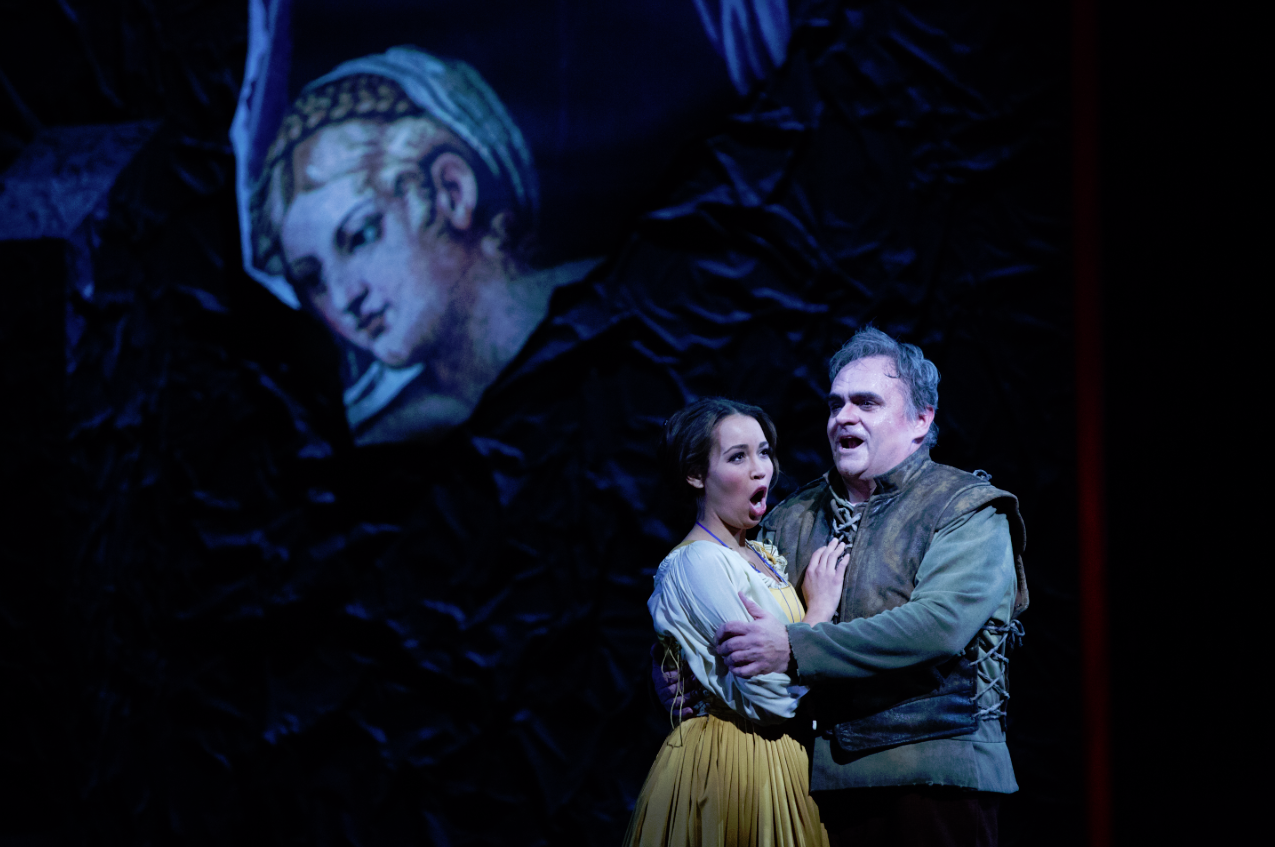
Our production remains in the original setting of the Renaissance, with elaborate period costumes and painterly images. Hovering above our set is the pristine model of an unobtainable ideal city, based on a painting by Piero della Francesca. Below, we find ourselves drawn into the dangerous, corrupt court and that of a sinister, dark world around it. The shadowy world of the Duke is ruled by desire and the pursuit of power. The courtiers become voyeurs to the Duke’s entertainments and wait like birds of prey for their share of the spoils. Those who fall victim to the quickly shifting alliances at court will surely find dishonor, or even death.  At the end of the first scene, Rigoletto and the Duke are cursed by Monterone, one such dishonored courtier. This curse represents a moment of mental collapse for Rigoletto and becomes the catalyst for the events of the opera.

The jester instantly begins to view the world through a lens of fear and paranoia that confuses nightmares with reality. Images from the Duke’s court reappear and become increasingly distorted and grotesque as Rigoletto is overwhelmed by his obsessive fear. Outside of the court, the world is dark and empty. In Rigoletto’s home, there is only an angelic visage watching over his daughter Gilda. This image represents the mother figure that Gilda so desperately clings to as a source of hope and salvation. In the final scene, there is only the image of a body with no face, representing both an object of desire and the indifferent fate of Sparafucile’s victim. The imagery becomes more heightened and focused until finally Rigoletto is left alone in the dark with only the ideal city to remind him how far he has fallen. This production is an exploration of the psyche of Rigoletto, while always seeking to honor Verdi’s idea of the character as “grossly deformed and absurd but inwardly passionate and full of love.”

-Stephanie Havey


October 13 & 14  |  7:30 PM  |  DeVos Performance Hall

OPERA  |  CLASSIC  |  DRAMA  |  ITALIAN

Italian grand opera at its finest.