
Artist spotlight: Rachel Mills

Name: Rachel Mills
Voice Part/Title/Instrument: Soprano
Most Recent Role with Opera Grand Rapids: Papagena, The Magic Flute
Production Year: 2018

Where are you originally from?
I moved around a lot as a kid, but mostly grew up in GR!

Who has inspired you/been your greatest influence professionally? Why?
My mother – she had an amazing voice I never grew tired of listening to and always gave constructive criticism with buckets of encouragement. She passed way this year, but she keeps encouraging me in my memories, dreams, old messages, and even a note she left before she died for opening night of Marriage of Figaro.

Who/what brought you into the world of Opera?
I wanted to go into musical theatre and thought opera was boring when I was a teenager. My dad planted the seeds be essentially conducting an independent study for me after school! He made me listen to opera recordings and follow along in the libretto, explaining what made each singer great and some historical context of each opera. I still went to ASU for musical theatre, but my teacher encouraged me to study opera as well, and when I hear the opera student warming up in the practice room hallway, I was hooked!

Where do you live now?
Home is GR, but my husband works in Abu Dhabi so we live out there half the year!

What are your hobbies when not performing?
I teach voice lessons and run a non-profit with my family that gives full scholarships to at-risk, inner city youth for summer music camp. Those things along with being a mom to a highly active toddler take up all my time! But, I also love baking, reading, traveling, and drinking lots of tea!

What is your favorite Role/Opera/Piece?
Honestly, I don’t think I will ever love a role more than Papagena! I think she is my spirit animal! But my favorite opera…that’s tough! And it changes all the time. I think I’ve never been so moved by an opera than I was by a production of Pelleas et Melisande at Welsh National Opera in 2015.

What is your favorite things about being a professional musician?

Traveling and meeting so many people with fascinating stories. I actually met my husband traveling to Oman with a production of La Boheme. He was a lighting technician at the opera house and loitered outside my dressing room waiting for a chance to sweep me off my feet!

Least favorite: It’s not always possible for my son and/or husband to travel with me, and the separation is really difficult.

What is something you enjoyed about being in Grand Rapids?
It’s home! I have loads of family to take care of my son and always see friends and family in the audience. Grand Rapids has such a small-town community feel, but with all the curiosity and culture of a big city. It’s a wonderful, exciting cozy, friendly place to be!

Where is your favorite place to travel/perform? Why?
To perform, most definitely Grand Rapids. Since its home and I have such overwhelming support there. It’s also nice to come home to my own bed after a long rehearsal and to know that I have a crowd of people willing to babysit in exchange for hugs and baby smiles.

To travel, my favorite so far is Sri Lanka. It’s a simple, gorgeous paradise full of kind and generous people and excellent tea.

What performances/plans do you have in the next year?
I am performing a small recital tour with a pianist I met in Abu Dhabi. We perform in Dubai, Budapest, Sopron, Fairfield, CT, and here in grand Rapids through December & January. Inspired by the enormous expat community in the UAE, we have 6 languages on the program, including works by Kodaly, Rachmaninoff, Debussy, and barber, plus a few arias. December 29th at Trinity Lutheran Church in GR!

Rachel as Papagena in Opera Grand Rapids' 2018 production of The Magic Flute

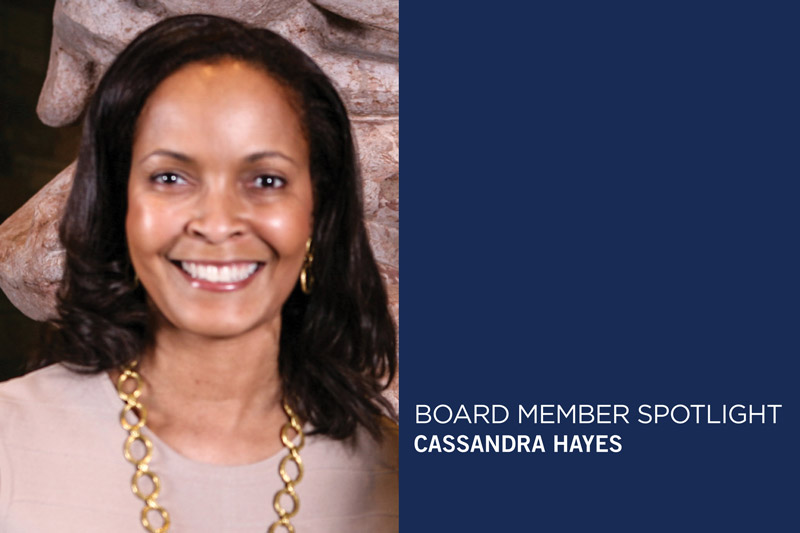
CASSANDRA HAYES: NYC Native and world traveler

Opera Grand Rapids Board Member Spotlight

Where are you originally from?
New York City

What do you do for a living?
Communications Manager at Amway – Americas Region

Where is your favorite place to travel? Why?
I still have the travel bug after 23 years as a flight attendant. Paris and St. Maarten are my favorite places.

What/Who got you involved with OGR?
(Past and Current)

I was recommended by a former board member when I first moved here in 2013. This is my second term on the board after a two-year hiatus.

What do you like about Opera?
Growing up in New York, I spent a lot of time at Lincoln Center attending the arts that were featured and have fond memories of operas such as The Barber of Seville and Carmen. I found opera more accessible out of all classical music because it was classical music with a narrative and actors. I was also amazed by the “athleticism” of the voices. Opera singers must learn music theory and history, sight-reading, acting, dancing, diction and multiple languages in addition to their vocal studies – it’s quite impressive.

Who/what brought you into the world of Opera?
I had a classmate who studied piano and played at Carnegie Hall at the age of 11. Her parents helped us experience the arts throughout New York City.

What is your favorite form/piece of art? (symphony, opera, painting, book, etc.) Why?
The first aria I remember really paying attention to is “Largo al Factotum” from Barber of Seville and it has remained with me as one of my all-time favorites. “Nessun Dorma” – I love when the tenor hits those glorious notes and the orchestra swells behind him. I would say I’m an opera novice and serving on the board also serves as a profound learning experience for me, too.

Why do you think it is important to have an Opera company in our community?
It is the inspiration behind much of today’s pop culture, for example, Madame Butterfly inspired the musical Miss Saigon and La Boheme inspired RENT; the band Queen uses classical music in some of its songs and the Queen of the Night aria is the centerpiece of a Volvo commercial. Opera is all around us and a community opera company helps to bridge the chasm.

Queen of the Night at ArtPrize

ArtPrize 10 brings opera to life again this year. Here are 10 opera-themed exhibits to include in your ArtPrize tour before you attend the Opera Grand Rapids Season Kick-Off Party on September 28. Most notable is a nod to our premiere opera this fall, Mozart ‘s The Magic Flute.  The “Queen of the Night” aria is depicted in three watercolor abstracts by Peg Sandin at the Venue Tower Apartments.
ArtPrize is an open, independently organized international art competition that takes place in Grand Rapids over 19 days every other fall. Rapids. More than $500,000 in prizes are awarded each year, which include a $200,000 prize awarded entirely by public vote and another $200,000 prize awarded by a jury of art experts.

1. Queen of the Night: The excitement of the opera “The Magic Flute” is captured in lively 2-D watercolors on display at the Venue Tower Apartments.

2. First Flute: This welded metal wall composition, inspired by the idea of primal music being forged by the forces of Nature, can be seen at the Monroe Community Church.

3. Flute with Attitude: This 2-D oil painting is a celebration of whimsical music located at the B.O.B.

4. Opera Offering: Inspired by the Metropolitan Opera and composers Philip Glass, Terry Riley and Arturo Toscanini, this large scale 2-D laser print is combined with the surprise of sound and located at Grand Rapids City Hall.

5. The Last Bird on a Rainy Twilight: Existentialism is on display in this oil paintingdepicting “the last flying of the bird (of its own race) in a rainy morning is a warning for 21st-century thoughtful man” at Sweet House.

6. Silent Chorus: Showing at the Fountain Street Church, this sculpture uses the tragic chorus in classic theater – where the collective stood for the personal and was used to discuss issues affecting individuals and state – to depict the silent voices of women victims.

7. Society: This acrylic on silk painting of gray cinder blocks represent“a collection of similar, but unique, individuals that come together for a common purpose.” For some viewing it at the DeVos Place Convention Center, it may connote a “society of secrets” and the geometrical and architectural theme of Freemasonry.

8. 1934: This portrait of a young President Gerald Ford – a freemason – and Willis Ward is made up of 1934 thousand pieces of ripped paper and reference images from 1934. It is displayed at the Gerald R. Ford International Airport.

9. Satellite Collective’s Echo & Narcissus: Song, words and images come together in this 10-minute vocal and hand projected performance – an aria to illuminate the unrest and discord of our moment is featured at SiTE:LAB.

10. Orpheus: This is a mix of ancient Greek legend, Austro-Italian opera and German poetry, blended with the crafts of photography, song, poetry, recitation, translation and technology. The closing lyrics are thought to be the first time the aria has been sung in Greek. View it at the The ArtRanger – Mobile Art, Performance and Augmented Reality Experience.

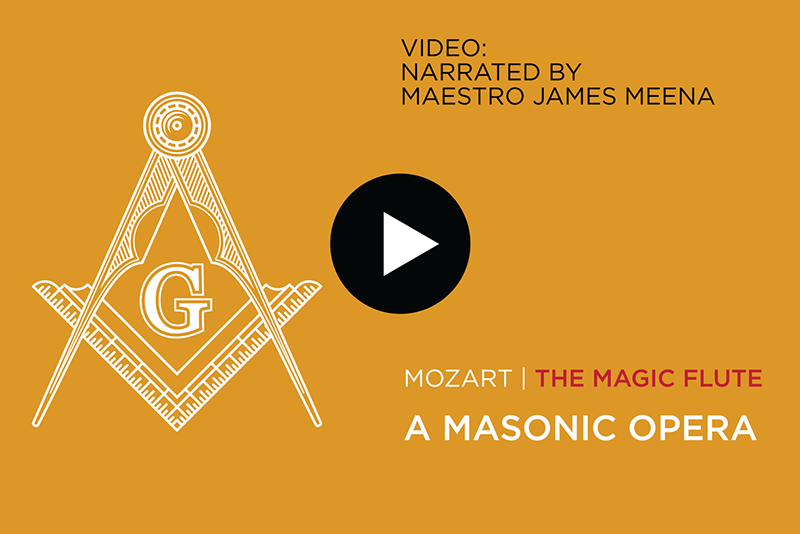
Mozart’s The Magic Flute: A Masonic Opera

Mozart - the magic flute - a masonic opera narrated by Maestro James Meena Mozart’s The Magic Flute is universally recognized as being a masterpiece among masterpieces. This opera is an allegorical tale, not a fairy tale, and uses symbols to express truths about the human spirit. The overarching theme is: Harmony in human society can only be realized by the perfect union of man and woman, characterized by an equality that is achieved through pure love, strength of character, and the rituals of Freemasonry.

Mozart, like many of the Founding Fathers of the United States, was a Freemason. In the late 18th century, Freemasonry was considered a radical movement, aligned with the free thinkers of the Enlightenment. It was a threat to the aristocracy and established religion and, as such, was suppressed by the nobility and Vatican.

The opera is set in two polar opposite kingdoms: The Kingdom of Night – symbolized by the moon and the color silver, and ruled by the Queen of the Night. The Queen represents the Austrian empress Maria Theresa who oppressed Masonic Lodges. The Kingdom of the Temple of the Wisdom is symbolized by the sun and the color gold, and is led by the High Priest Sarastro who represents Ignaz von Born, leader of the Vienna Masonic Lodge of which Mozart was a member. These two kingdoms will only be reconciled by the union of opposing kingdom prince and princess Tamino and Pamina, respectively, and the victory of the sun (enlightenment) over the moon (the established order).

When we first meet Tamino he is running in fear from a serpent that represents his irrational ignorance of the Masonic Order. He is then lied to by the Queen to the Night and sent off to rescue her daughter Pamina from Sarastro. The rest of the opera is occupied by Tamino and Pamina finding pure love and enduring the Masonic trials of self-discipline through silence. They are ultimately purified by the basic elements of fire and water. Once they have successfully gone through these trials, Sarastro gives them the shield of the sun to be wise and benevolent rulers.

And why a magic flute? A common Masonic theme is that music has the power to transcend human fear and hatred. So, the moral of the story is that through the Masonic Order and guided by the beauty of music, society is enlightened – men and women equally.

The most memorable character in The Magic Flute is Papageno the birdcatcher, who was created to entertain the audience and further obscure the Masonic messaging of the plot. For the opera’s premier performances, the role of Papageno was played by actor Emanuel Schikaneder. Schikaneder was also the librettist for The Magic Flute and the owner of Teatre on Der Wien where the work premiered. Papageno is an Everyman and endures his own set of trials, at which he fails miserably. Yet, the kindly gods provide him a beautiful young wife and our Everyman couple populate the world with many little Papagenos and Papagenas. It’s a bit of a cynical comment that while there are few Taminos and Paminas, there are many Papagenos and Papagenas.

But why not just come out and say all of this? Well, remember that at the time of Mozart, Freemasonry was under a Papal bull of condemnation, and suppressed by the nobility. It was not only unfashionable, but potentially dangerous to be a Freemason. As you enjoy the delightfully brilliant music of Mozart in The Magic Flute, keep in mind the philosophical journey toward enlightenment that is shared by Tamino and Pamina.

Opera Grand Rapids’ production of Wolfgang Amadeus Mozart’s The Magic Flute is being performed, in English, October 26th and 27th at DeVos Performance Hall. The production stars acclaimed artists John Viscardi as the comic Papageno and Jana McIntyre as the star-blazing Queen of the Night, with the Opera Grand Rapids Chorus and the Grand Rapids Symphony under the baton of Artistic Director, Maestro James Meena.

Initiation ceremony in a Viennese Masonic Lodge, during reign of Joseph II. The inside of what is thought to be the lodge New Crowned Hope (Zur Neugekrönten Hoffnung) in Vienna. It is believed that Wolfgang Amadeus Mozart is depicted at the extreme right, sitting next to his close friend Emanuel Schikaneder. Painting by Ignaz Unterberger (1748-1797) Click here to learn more.

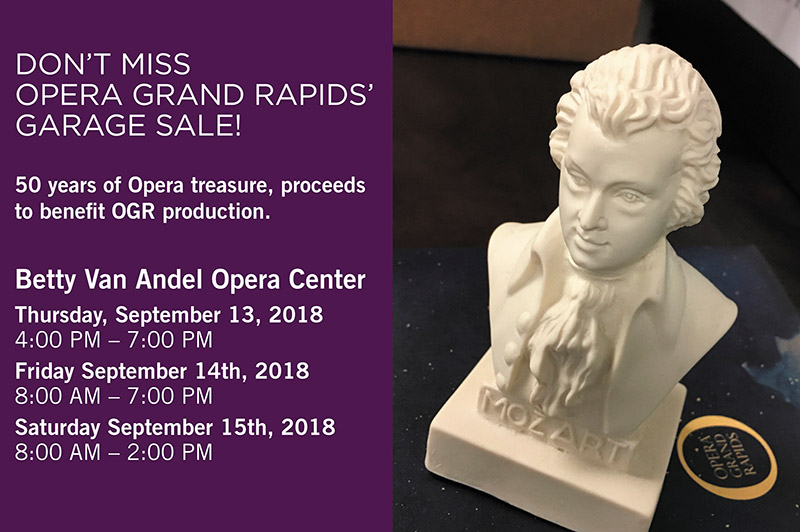
Garage Sale: Opera Grand Rapids 50 Years of Treasures

The Betty Van Andel Opera Center is packed full of 50 years of memories, costumes, props, and frankly…too much stuff! In order to make a clean start for the next 50 years, we are holding a Garage Sale!

Fabric, costumes, props, furniture, LPs, stacking chairs, tableware, silk flowers, binders, opera memorabilia, and so much more!

All proceeds from the Garage Sale will go to purchase needed materials for the Opera Center and support the coming season’s productions and programs.

Betty Van Andel Opera Center
Thursday, September 13, 2018 | 4:00 PM – 7:00 PM
Friday, September 14th, 2018 | 8:00 AM – 7:00 PM
Saturday, September 15th, 2018 | 8:00 AM – 2:00 PM