
Growing Grand Rapids through the arts


This story is part of a series of 50 stories we are releasing to commemorate 50 years of opera in West Michigan. Browse more stories and follow our journey throughout the season.


“[All regions] are fighting for the same things, business and talent. Having an opera company is one of the ways Grand Rapids makes a strong case as a city where skilled and sophisticated people want to live.” – Birgit Klohs, President and CEO of The Right Place

“When you drop somebody into Grand Rapids today, they’ve never known it any other way. But those of us who have been on this journey for thirty years have really seen how it has changed,” says Birgit Klohs. As the President and CEO of The Right Place—a leading regional development association in West Michigan—Klohs has been part of Grand Rapids’ explosive growth over the past three decades.

When Klohs began her tenure as CEO in 1987, she was impressed with the area’s successful business legacy, but she saw room for growth. “It was a good city, but it certainly could be much better,” she recalls thinking. “Many of us in the business community, the philanthropic community, the arts community, and public partners all pulled together and said, ‘How can we improve what we have?’”

During those years, the community’s most influential business leaders made a conscious decision to transform Grand Rapids into a richer, more cosmopolitan place over the course of a generation. “It included all of the happenings downtown, the Arena, the Convention Center, the Civic Theater, Meijer Garden,” says Klohs.
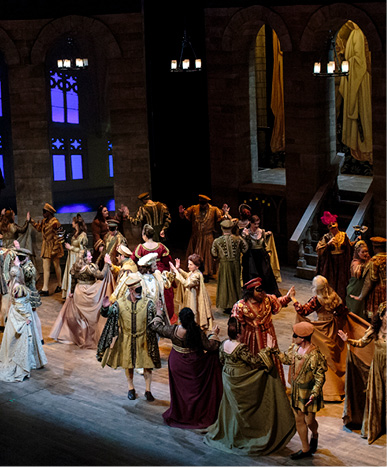
Opera Grand Rapids “Romeo and Juliet”

Creating a diverse, thriving city of the future means making West Michigan attractive for entrepreneurs and corporations, but it also means investing in the arts. “If we don’t have a robust, rich arts community, the community cannot thrive the same way,” say Klohs. She says that a regional landmark city like ours needs everything from an opera house to golfing options to attract and retain talent, and talent is the backbone of business. Klohs has watched Grand Rapids grow for decades, and she emphasizes the need to continue fostering growth in the arts. “We are really fighting above our weight class, when it comes to offerings in the arts in this region, and obviously the opera is a big part of that.”

Arts organizations like ours can be drivers for the economy on many levels. According to the National Endowment for the Arts, spending on performance arts tickets has doubled since 1998. Each year sees small but steady growth in the overall GDP of the arts and being connected to that economy helps Grand Rapids in ways both obvious and subtle. Grand Rapids’ music scene, for instance, includes avant-garde and indie acts who perform at Pyramid Scheme, our Symphony Orchestra, Opera Grand Rapids, folk festivals, hip hop groups, and everything in between. Each of these acts and organizations requires staff, accommodations, venues, and meals when they perform; the same is true of their audiences. Most people who visit the city for its music will stay in a hotel and eat two or three restaurant meals.

Besides the direct economic benefits, this variety of performance art options adds a metropolitan polish to our city. “We have to continue to work, to stay ahead of the competition, quite frankly,” Klohs says. To ensure Grand Rapids’ regional powerhouse status as a city, it is important to maintain unique offerings that draw in a diverse talent pool and keep us in the conversation. “[All regions] are fighting for the same things, business and talent,” she says. Having an opera company is one of the ways Grand Rapids makes a strong case as a city where skilled and sophisticated people want to live, according to Klohs. That’s one of the many reasons the business leader has supported the opera since moving here from Germany. Despite her professional interest in the arts as a business development professional, Klohs’ interest in opera began like any other patron’s—with a love of the music.

As a twelve-year-old, Klohs was taken to the opera for the first time in her native Germany. “I’ve enjoyed opera ever since,” she says. “I’ve gone to opera houses all over Europe, and when I moved to Grand Rapids, I was very pleased to see we had an opera company. I started buying season tickets. A few years after taking the position as CEO of The Right Place, I joined the Opera Board,” says Klohs. She thoroughly enjoyed her role in guiding the opera during her nine-year tenure on the Opera Grand Rapids Board of Directors. She is proud to help us celebrate our 50th anniversary as a patron, adviser, and friend. Says Klohs, “It’s been an unbelievably great ride, to participate in and lead the redevelopment of this area for the past thirty years. It’s just been the most phenomenal job anybody could wish for.”

OUR FOUNDERS HAD A BOLD PROPOSITION: to build a professional opera company that would put Grand Rapids on the map for a very discerning audience. 50 years later, we are humbled to be the modern bearers of classical standards and modern ingenuity. Learn more.


SUPPORT OUR NEXT 50 YEARS

As an integral part of our city’s artistic fabric, it’s our responsibility to see to its continual flourishing. Please consider donating to Opera Grand Rapids to ensure our artistic excellence for the next 50 years and beyond. You’ve already made us great. With your support, there’s no limits to the height our voices can reach together. Give today.

Why we need more people of color represented in opera


This story is part of a series of 50 stories we are releasing to commemorate 50 years of opera in West Michigan. Browse more stories and follow our journey throughout the season.


People of color have a substantial tradition of building the opera in America, but that fact is often obscured. Contemporary artists are fighting hard to change that.

Opera Grand Rapids “I DREAM”

The art form of opera is about four hundred years old. It originated as an entertainment for the court of Mantua, the modern capital city of the province of Lombardy, Italy. Many Italian cities during that period were cosmopolitan; craftsmen, textile workers, and spice merchants from all over Europe and the Muslim world visited and lived in Mantua. And where there was trade during that era, there were slaves, usually taken from Eastern Europe, Greece, and Central Asia.

Given the mores of the time, people from foreign lands (not to mention slaves) were not generally allowed to perform for the court or the public. Unsurprisingly, opera was a largely Italian affair for its first few decades of life. Then, in 1627, the German opera tradition was born with Heinrich Schütz’s Dafne. Soon, traveling troupes would acquaint the Russians with the art form. France, Spain, and China would develop their own operatic traditions during the following centuries.

Opera evolved during the same time as the Enlightenment planted the first roots of a humanism that would ultimately destroy slavery, but the process took centuries. As a European artform, performed in countries where ethnic minorities were usually slaves, serfs, or scarcely tolerated, it is tragically predictable that people of many backgrounds were never afforded an opportunity to be part of opera’s evolution. Notable exceptions do exist, however.

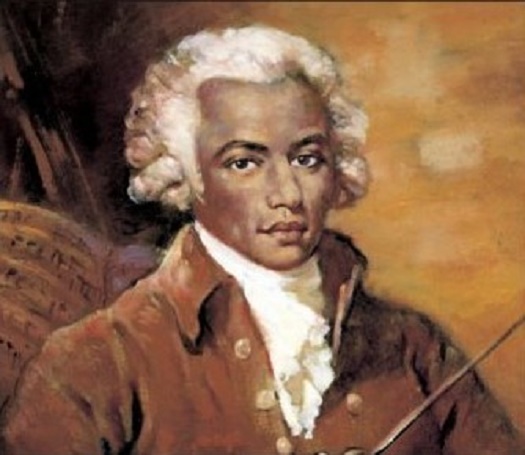
Joseph Bologne

Joseph Bologne, Chevalier de Saint-George, was a celebrated French violinist, composer, and champion fencer in the Age of Revolution. He was also the son of a planter and a slave. A prodigious musical talent, Saint-George composed, conducted, and played in the most prestigious musical institutions of the day. He nearly took the helm of the Paris Opera in 1776, but racism and fear of his rigorous methods caused divas among the company to protest his bid, and he withdrew. Not content to be a landmark figure in cultural circles, Saint-George went on to become a colonel in the French Revolution and lead Europe’s first regiment of black volunteers.

America was recovering from another war, in 1873, when the city of Washington got its first opera company. Only eight years after the end of the Civil War, The Colored American Opera debuted at Saint Augustine Roman Catholic Church. It was not unusual for black Americans to sing in church at the time, but an all-black choir singing sacred and classical music for the public was a rare thing indeed.

On February 3rd and 4th, 1873, The Colored American Opera Company staged its first and only production, The Doctor of Alcantara. One can imagine the skepticism of the local critical elite as they walked into the hall, especially considering the CAOC members’ lack of formal training. But newspapers of the day indicate the production soared past expectations. “We do not exaggerate when we say that this is one of the best choruses we have heard for some time,” said The Philadelphia Inquirer.

 In 2008, the story of the visionary singers of The Colored American Opera Company was told in a contemporary work: Free to Sing: The story of the First African-American Opera Company.  The production was conceived and performed by the Music Center at Strathmore, near Washington, DC, in Bethesda, Maryland. The production used narrative and musical elements, including opera, to explore the tale of former slaves and soldiers creating a musical institution amidst a hostile culture.

Of course, the story of American music in the twentieth century is largely the story of black music. Blues, jazz, funk, soul, gospel, and hip hop are the pillars on which much of our national musical identity is built. Today, some of the most visible and financially successful musicians in the world are black. But opera, and classical music generally, has been much slower to include people of color in its ranks. Still, we are seeing more librettists, composers, and singers of diverse backgrounds in the opera world than ever before.

Baritone Robert McFerrin

Some luminaries have lit the way for contemporary artists of color: the ninety-one-year-old Leontyne Price became a star at the Metropolitan Opera in the late 1950s. Robert McFerrin, Bobby McFerrin’s father, was the first African-American man to sing at the Met, in 1953. Mezzo-soprano Shirley Verrett sang for the Met for thirty years, from 1961 onward. Jessye Norman dazzled audiences at La Scala, Stuttgart, and throughout Europe in the seventies, before moving her career stateside.

People of color have a substantial tradition of building the opera in America, but that fact is often obscured. Contemporary artists are fighting hard to change that.

Lawrence Brownlee, artistic adviser at Opera Philadelphia, is intent on creating work that is about the black experience in America. Brownlee commissioned Cycles of My Being, a work about a black man who dies while in police custody, to put his anxieties about race relations front and center. Composed by Tyshawn Sorey, with lyrics by Terrance Hayes, Cycles goes to places that will make many people uncomfortable. But Brownlee is cautiously optimistic about the contemporary opera scene, in regard to race. But he still finds hurdles, even if they have taken subtler forms. As he told The Guardian last month, “You can’t blind-cast with opera. No one has ever turned me down for a part and said ‘Because he’s black’ or even ‘Because he’s small and black!’ but there’s a code I’ve come to understand – ‘We have a different idea for the role’ is a common one.”  He says that change is happening, however slowly, and that truly color-blind casting isn’t appropriate for the art, either—he quickly recuses himself from consideration for the title role of Verdi’s Otello, based on his vocal register.

Those interested in contemporary black contributions to opera—whether of the black history or European pastoral variety—can find a handful of New York companies working to increase visibility. The Harlem Opera Theater, Opera Ebony, and Opera Noire of New York are all creating and performing innovative work in the opera space and giving people of color opportunities to take center stage. By performing works about Malcolm X, Robert McFerrin, and the modern racial landscape, these companies are leading the charge in making opera an accessible art form for people who are looking for something other than Rigoletto. The efforts of contemporary African-American composers and performers are giving America a timeless gift: they are using American voices to tell quintessentially American stories.


OUR FOUNDERS HAD A BOLD PROPOSITION: to build a professional opera company that would put Grand Rapids on the map for a very discerning audience. 50 years later, we are humbled to be the modern bearers of classical standards and modern ingenuity. Learn more.


SUPPORT OUR NEXT 50 YEARS

As an integral part of our city’s artistic fabric, it’s our responsibility to see to its continual flourishing. Please consider donating to Opera Grand Rapids to ensure our artistic excellence for the next 50 years and beyond. You’ve already made us great. With your support, there’s no limits to the height our voices can reach together. Give today.

The opera that received encores for almost every scene

Mozart’s Le Nozze di Figaro

Premier, Vienna, 1 May 1786

Joseph II, Holy Roman Emperor

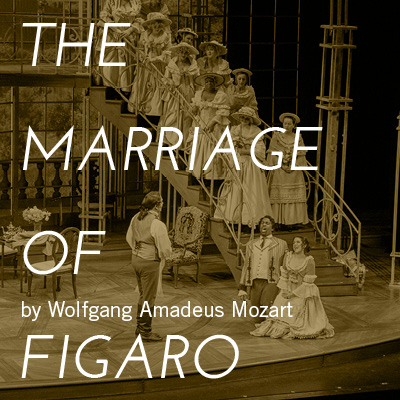
The Marriage of Figaro is opera’s longest running hit. Since opening 232 years ago at the Vienna Burgtheater, it has never required reviving. Even the efforts of Salieri, Righini, and Martini—infamous in­triguers of Emperor Joseph’s Court—could not blunt Figaro’s success. Vien­nese audiences saw nine perfor­mances that season and their en­thusiasm resulting in repeated calls for aria encores. In his memoirs, Michael Kelly, the Anglo-Irishman who sang the roles of Basilio and Don Cur­zio, tells us: “almost every scene was encored, which pro­longed it nearly to the length of two operas, and induced the Emperor to issue an order, on the second presentation, that no piece of music should be en­cored.” The order was politely ignored.

Figaro’s appearance in Prague (the Austrian Empire’s other ‘capital’) was even more successful. In his letters home, Mozart reported: “Here they talk about nothing but ‘Figaro’. Nothing is played, sung or whistl­ed but ‘Figaro.’ No opera is draw­ing like ‘Figaro.’ Nothing, nothing but ‘Figaro.’” So complete was Mozart’s success, it led immediately to the Don Giovanni commission, a marvelous conse­quence, indeed.

Lorenzo Da Ponte

For Figaro, Mozart turned to Pierre Augustin Caron de Beaumarchais’ play, Le mariage de Figaro (1778), the second part of his stage trilogy that included Le barbiere de SéviIIe, and La Mère coupable (The Guilty Wife). Mozart was sufficiently impressed with the play (which he must have read, since its performance was banned in Vienna) to risk both censorship and the Emperor’s displeasure. Selecting Lorenzo Da Ponte to write the libretto, Mozart for once showed a little political savvy since Da Ponte was able to persuade Emperor Joseph the play was not revolutionary by deleting its political speeches. In his delightful, self-aggrandizing memoir, Da Ponte takes full credit for sanitizing Figaro by “expunging those incendiary passages.”

As a consequence, in the opera Figaro does not upbraid the Count by reminding him that an accident of his birth is his sole claim to fame: “Because you are a great noble you believe you are a great genius. Nobility, fortune, rank, position, what have you done to deserve all these goods? You went to the trouble of being born—nothing more!” In the late 18th century this was strong stuff, and in France Beaumarchais paid for it with a stint in the Saint-Lazare jail. But in Vienna, Da Pointe was aware of the Emperor’s feelings of contempt for hypocritical aristocrats, as well as for those untitled “royals” who all owed their wealth and eminence to the accident of birth.

Thus, for the libretto, Da Ponte drop­ped the provocative political speeches but changed little else in plot and structure. His creative energies went into inven­ting arias where only a line or two of dialogue exists in the play. And this genius for dramatic revelation inspired Mozart’s incredible music. And what music it is: so rich and varied as to be positively breathtaking. Yet, its beauty is always employed in delineating character and heightening the drama. In Mozart’s adaptation, Beaumarchais’ glib, sometimes  superficial characters are transformed in­to complex ones, especially the three principals: Figaro, Susanna, and the Countess.

After The Marriage of Figaro’s sensational Vienna opening run, popular though it was with the general public, it became Mozart’s undoing at Court. Viennese aristocrats, as well as those un­titled members of the upper­ class, were accustomed to see­ing themselves glorified in opera. Indeed, Mozart’s two preceding works—Idomeneo (1781) and The Abduction from the Seraglio (1782)—conventionally glorified their aristocratic characters, portraying them as both generous and noble, while their servants are properly respectful and faithful. But after the ‘insult’ of Figaro, Mozart lost the precious little patronage he enjoyed for subscription concerts and new work com­missions. Viennese ‘royals’ were not amused that Count Almaviva, the opera’s only representative of the privileged class, was so complete­ly put down by his wife, in league with mere servants. They found nothing comic about this; rather, they found Mozart and his opera insolent.

The Mozart-Da Ponte collaboration produced two more opera—Don Giovanni (1787) and Così fan tutte (1790)—both of which enjoyed more favor with Prague audiences than with Viennese. And only in Don Giovanni did the libretto center on the affairs of an aristocrat, this one a famously reckless, even cruel, womanizer. But much of the class sting was glossed over by the fact that the Don Juan legend had its own mythical history. Taken together, all the Mozart-Da Ponte operas set a standard for music and story that has never been surpassed.

The Marriage of Figaro, 1967

On this special occasion, it is well to remember that The Marriage of Figaro was the calling-card production for the Opera Association of Western Michigan (as Opera Grand Rapids was then known) in 1968, when locally produced opera began in Grand Rapids. It was an ambitious undertaking, one that has proved the local group was up to the challenge. And for the next 50 years that challenge has been repeatedly met with ever-increasing standards of excellence. It is therefore especially fitting we celebrate this 50th anniver­sary of Opera Grand Rapids with this new production of Mozart’s masterpiece.


by Gilbert R. Davis

Dr. Davis, GVSU Emeritus Professor of English, has been writing Opera Grand Rapids program notes since the 1970s, and with this one bids a fond addio.


May 4 & 5  |  7:30 PM  |  DeVos Performance Hall

OPERA  |  CLASSIC  |  COMEDY  |  ITALIAN

The quintessential comic opera.

Tickets and more.


Showmance: Finding love on the opera stage


This story is part of a series of 50 stories we are releasing to commemorate 50 years of opera in West Michigan. Browse more stories and follow our journey throughout the season.


In the industry, they call this phenomenon a “showmance.” It’s such an established idea that performers who become infatuated during a show are often skeptical of their own feelings.

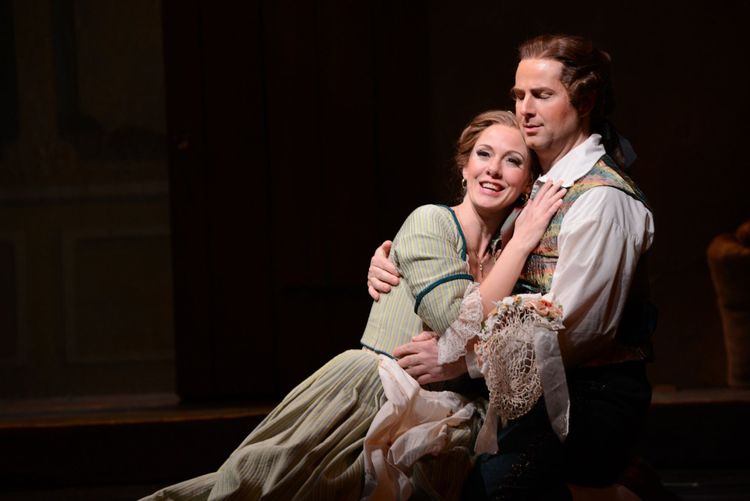
Real-life wife-and-husband Anne-Carolyn Bird and Matthew Burns

Opera and romance have a fraught relationship. Between the heartbreak, kidnapping, imprisonment, and worse, opera narratives are not an easy place to find love. Since conflict is at the center of all storytelling, there is no end to the tribulations onstage lovers must endure. For opera characters, a successful first date is one that finds each of them still standing by the end.

After weeks of long rehearsals, staring longingly at one another, and dying in each other’s arms every night, opera’s amorous intensity can find its way backstage and into the lives of the actors themselves. In the industry, they call this phenomenon a “showmance.” It’s such an established idea that performers who become infatuated during a show are often skeptical of their own feelings.

“When he walked into the room, it was like all the lights came on, and my heart pounded in my chest,” said Anne-Carolyn Bird in a 2008 MLive feature about her opera romance. “It’s called a ‘showmance,’ and we wanted to be sure we weren’t falling prey to it.”

Bird met her husband, Matthew Burns, when the two played the parts of young lovers navigating The Marriage of Figaro’s “day of madness” together. In the opera buffa tradition, the two had multiple run-ins with one another, including an accidental one on the street in Manhattan. Their chemistry during the show was apparent to all. Bird recalls that an audience member told him she had “never seen two people look so much in love on stage as you two.”

After Figaro concluded, the two actors went their separate ways. But, as fate would have it, they found themselves together again three weeks later—in an Ohio production of The Barber of Seville. Deciding not to try and thwart the wiles of destiny any longer, the pair rendezvoused when they returned to their homes in New York.

“When we had our first date, there wasn’t any tension about that first kiss,” said Burns.

The Opera Grand Rapids stage is no stranger to flying sparks. Alto Barbara Osburn and bass Mark Mullinax met in the chorus of the 1993 production of Carmen. When they saw each other again, it was as onstage lovers, in Romeo et Juliette—four years later. As soon as the production ended, they went on a date. Now, the married couple continues to sing together.

Art and Ashley Wallace met in 2007’s Carmen. Ashley—then a Zentmeyer—won Opera Grand Rapids’ 2008 Collegiate Vocal Competition, and met Art during her first run on the OGR stage.

The shy Art was reluctant to approach Ashley, but enough time singing together brought out his natural humor. By the staging of The Flying Dutchman, at the end of the season, the two were getting along swimmingly. They went on a date, and in 2009, they got married.

For our characters, romance tends to be a series of tragedies or farcical mishaps. We’re overjoyed when their offstage counterparts find real, durable love and bring it from our stage into the world.


OUR FOUNDERS HAD A BOLD PROPOSITION: to build a professional opera company that would put Grand Rapids on the map for a very discerning audience. 50 years later, we are humbled to be the modern bearers of classical standards and modern ingenuity. Learn more.


SUPPORT OUR NEXT 50 YEARS

As an integral part of our city’s artistic fabric, it’s our responsibility to see to its continual flourishing. Please consider donating to Opera Grand Rapids to ensure our artistic excellence for the next 50 years and beyond. You’ve already made us great. With your support, there’s no limits to the height our voices can reach together. Give today.

Remembering trailblazing opera singer Catherine Barrow-Williams


This story is part of a series of 50 stories we are releasing to commemorate 50 years of opera in West Michigan. Browse more stories and follow our journey throughout the season.


Catherine Barrow-Williams, Opera Grand Rapids first African American opera singer, established herself during a time of unprecedented racial tension.

Marriage of Figaro feat. Catherine Barrow-Williams

Catherine Barrow-Williams first performance with Opera Grand Rapids took place during the long hot summer of 1967, when American cities would be decimated by race riots, and interracial marriage was a legal issue to be decided by the Supreme Court. As Grand Rapids’ first African American opera singer, Williams established herself in an overwhelmingly white art form during a time of unprecedented racial tension. She sang in The Marriage of Figaro, the very first performance by the organization that would eventually become Opera Grand Rapids. The entire production received enthusiastic reviews and put opera in Grand Rapids on the map.

Catherine Barrow-Williams

While unquestionably a trailblazer, those who knew her remember her as much for her compassion as for her courage. Known as “Mama Cathy” to those in her congregation, Catherine often opened her home to those in need. She and her husband, Bishop John, were known to provide food, transportation, and spiritual guidance to anyone who fell into their orbit.

Cathy’s zest for life can be seen in a video uploaded to Youtube by a member of her congregation. Taken just a month before she passed away, the video shows Cathy and members of her ministry on the way back from a conference in Cincinnati. As an elder of her congregation, Cathy was a spiritual leader, but that didn’t stop her from setting an example in other ways; in the video, taken in the early A.M., the bus is full of laughing, light, and singing, but it’s Cathy that stands up, claps her hands, and starts to dance.

Despite the often-fraught race relations in the late sixties, especially in her hometown of Detroit, Cathy said she always felt welcome in Grand Rapids. “God knew best. He brought me here. It was the best thing that ever happened to me, raising my kids here in Grand Rapids,” says Cathy in an interview during her final months. “As an adult, I went to Grand Rapids Community College, and I went to Grand Valley. I was a music major in school. And that was my life, singing. I was the first black opera singer here in Grand Rapids. I have been treated like royalty here. I love this town and I love the people.”

Cathy’s love for her eventual home didn’t stop her from seeing the world. As a missionary, she used the incredible gifts of her voice and her kindness to help hungry children on many continents. Said Cathy, “I’ve had the opportunity, as a missionary, to travel to over thirty countries. It’s been a wonderful life for me.” She described herself as an “instrument of peace,” and that was apparent in everything from the way she smiled to how she spent her time on earth.

Opera Grand Rapids is lucky to have had the honor of Cathy’s presence, both onstage and off. She secured her place in our history and our hearts.


OUR FOUNDERS HAD A BOLD PROPOSITION: to build a professional opera company that would put Grand Rapids on the map for a very discerning audience. 50 years later, we are humbled to be the modern bearers of classical standards and modern ingenuity. Learn more.


SUPPORT OUR NEXT 50 YEARS

As an integral part of our city’s artistic fabric, it’s our responsibility to see to its continual flourishing. Please consider donating to Opera Grand Rapids to ensure our artistic excellence for the next 50 years and beyond. You’ve already made us great. With your support, there’s no limits to the height our voices can reach together. Give today.