This story is part of a series of 50 stories we are releasing to commemorate 50 years of opera in West Michigan. Browse more stories and follow our journey throughout the season.
With New York Fashion Week upon us, we revisit some of the most stylish patrons of New York’s venerable opera house.
The Metropolitan Opera is known for its elaborate costume design on the stage, but for celebrity and elite patrons attending the opera, what’s worn to the performance is just as important. The opera house understands this well, and has taken the initiative of featuring the fashions of its opera attendees through “Last Night at the Met” social media platforms.
OUR FOUNDERS HAD A BOLD PROPOSITION: to build a professional opera company that would put Grand Rapids on the map for a very discerning audience. 50 years later, we are humbled to be the modern bearers of classical standards and modern ingenuity. Learn more.
SUPPORT OUR NEXT 50 YEARS
As an integral part of our city’s artistic fabric, it’s our responsibility to see to its continual flourishing. Please consider donating to Opera Grand Rapids to ensure our artistic excellence for the next 50 years and beyond. You’ve already made us great. With your support, there’s no limits to the height our voices can reach together. Give today.
This story is part of a series of 50 stories we are releasing to commemorate 50 years of opera in West Michigan. Browse more stories and follow our journey throughout the season.
From a hip-hop musical film starring Queen Bey to one the greatest cartoons of all time.
Opera is deeply ingrained in our popular culture. The art form has long been a rich source of themes seen in film, TV, advertisements, and more recently, video games. Opera has helped to amplify the most dramatic scenes in movies, inspired all-out parodies and fanciful plot devices, and added comic relief to a plethora of TV advertisements. We’ve collected some of our favorites below. Stay tuned. There will be more to come!
Citizen Kane
Citizen Kane, the 1941 American film by Orson Welles, features the character Susan Alexander–Kane’s love interest–in a humiliating operatic career for which she has neither the talent nor the ambition. Herman J. Mankiewicz, Welles’ co- screenwriter, intended to feature in the film an opera sequence from Jules Massanet’s Thais. Ironically, Massenet wrote the role of Thais for Sybil Sanderson who was, at one time, engaged to newspaper tycoon William Randolph Hearst–the man who’s life forms the basis of Welles’ film. However, due to copyright issues at the time of the film’s production, Herrmann instead wrote selections in French verismo style from the ersatz opera Salommbo.
Carmen the Hip Hopera featuring Beyoncé
Carmen is often thought to be the most popular and recognizable opera of all time. A quick search on the IMDb database results in an astounding 136 films that feature the opera’s famous “Habanera” aria. Queen Bey takes it a step further in this throwback made-for-tv musical film loosely based on the opera’s story. Borrowing elements of the opera’s themes of seduction and jealousy, Carmen the Hip Hopera is set in Philadelphia and Los Angeles in modern times and features a mostly original hip-hop/R&B score. The hip hopera features Beyoncé in her debut acting role.
Porgy and Bess‘“Summertime” by Ella Fitzgerald and Louis Armstrong
George Gershwin’s “Summertime” is recognized as one of the most covered songs in the history of recorded music, featuring over 33,000 covers. The song, from the 1935 opera Porgy and Bess, soon became a popular and much recorded jazz standard, described as “without doubt … one of the finest songs the composer ever wrote.” Jazz legends Ella Fitzgerald and Louis Armstrong offer their interpretation from their 1958 awarding-winning album of the opera considered to be the most musically successful among the jazz vocal versions of the opera.
Warner Bros. Cartoon “What’s Opera Doc?”
“What’s Opera, Doc?” is a 1957 animated cartoon musical short featuring Elmer Fudd chasing Bugs Bunny through a parody of Richard Wagner’s operas, particularly Der Ring des Nibelungen, Der Fliegende Holländer, and Tannhäuser. The cartoon borrows heavily from the second opera in the “Ring Cycle” Die Walküre, woven around the standard Bugs-Elmer conflict. The cartoon is widely regarded as Chuck Jones’ masterpiece, and many film critics, animation fans and filmmakers consider it to be the greatest of all Warner Bros. cartoons. It has topped many Top Ten lists of the greatest animated cartoons of all time. It was rated by a panel of over 1000 animators in Jerry Beck’s 1994 book The 50 Greatest Cartoons: As Selected by 1,000 Animation Professionals as the greatest cartoon of all time. In 1992, the United States Library of Congress deemed it “culturally, historically, or aesthetically significant”, and selected it for preservation in the National Film Registry, making it the first cartoon to receive such honors.
The Simpsons’ ‘Homer’ Sings Opera
The second episode of The Simpsons‘ nineteenth season features title character Homer Simpson who, after gaining the ability to sing opera following an accident, becomes a professional and famous opera star. There’s a catch, however: Homer must sing while lying on his back for his voice to sound operatic. Guests stars include Plácido Domingo as himself and Maya Rudolph. The episode was nominated for a Writers Guild of America Award in 2008.
OUR FOUNDERS HAD A BOLD PROPOSITION: to build a professional opera company that would put Grand Rapids on the map for a very discerning audience. 50 years later, we are humbled to be the modern bearers of classical standards and modern ingenuity. Learn more.
SUPPORT OUR NEXT 50 YEARS
As an integral part of our city’s artistic fabric, it’s our responsibility to see to its continual flourishing. Please consider donating to Opera Grand Rapids to ensure our artistic excellence for the next 50 years and beyond. You’ve already made us great. With your support, there’s no limits to the height our voices can reach together. Give today.
This story is part of a series of 50 stories we are releasing to commemorate 50 years of opera in West Michigan. Browse more stories and follow our journey throughout the season.
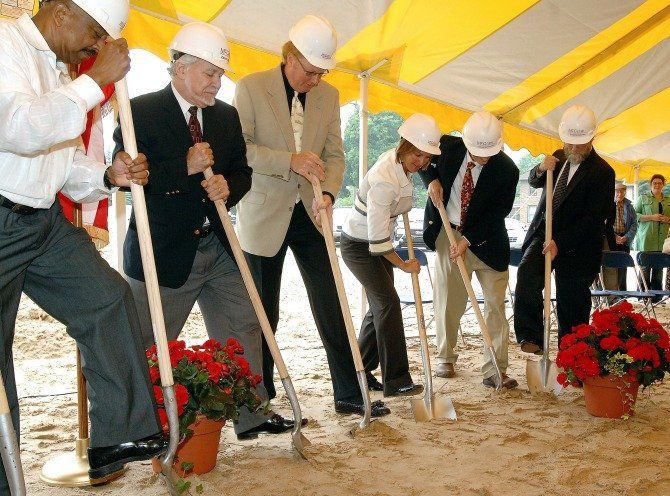
Betty Van Andel Opera Center Groundbreaking (photo courtesy MLive)
“Good buildings come from good people and all problems are solved by good design.” – Stephen Gardiner
Have you ever tried sharing a (big) pizza with three friends, only to have the planning phase devolve into bedlam? Toppings are suggested and sneered at, hands are thrown in the air, someone claims they “like everything,” but they don’t. Late in the discussion, someone reveals he’s allergic to pineapple and the mere threat of its presence is enough for him to opt out altogether.
Now imagine you’re ordering a pizza with these friends, but the pizza is about fourteen thousand square feet. It will have 862 toppings, with extra cheese on one slice only, and you have to cook it while stepping over and around a live power line that’s draped across the kitchen. This is, more or less, the story of the Betty Van Andel Opera Center building.
But there’s nothing uniquely byzantine about the saga leading to the Opera Center’s final home on East Fulton Street. False starts, left turns, compromises, and thorny situations are the order of the day in the development and construction game, according to Paul McGraw, President of McGraw Construction. It’s just that most people don’t have a window into the epic prelude to a building’s actual construction.
Like the best stories, the Opera Center’s began humbly, borne of necessity. “Originally, the Opera was almost begging and borrowing spaces to rehearse in. These spaces were generally a landlord who had a large vacant building. Traditionally those are pretty run down spaces. For a while they were rehearsing in an old Fruit Basket Flowerland,” says McGraw. For a time, strip mall patrons carrying Chinese takeout may have cocked their heads, wondering if they really did hear a faint soprano voice issuing from the vacant storefront next to the discount fireworks shop.
The Opera was moving through rehearsal spaces as landlords and availability dictated. While some landlords donated their spaces, others did not. Scheduling was complicated, and the moves themselves were not easy—the Opera staff regularly had to drag its entire costume shop into dusty alcoves and unpack it, only to repeat the process a few days later. The situation ate at OGR’s funds, and tested the resolve of the staff, who had to continue running an opera company as nomads.
In the mid aughts, a group of city luminaries who loved and supported opera, including Carol Van Andel and Paul McGraw, began a development process that would take years. Each board member of the development committee had his or her own idea about the location, and whether a new or existing building should be used. “Altogether, I think we looked at about thirty properties,” says McGraw. “We were trying to find all the right conditions and the right location. Every time we looked at a new location, we had to run the financials behind it. There were huge amounts of moving parts involved.”
With a generous fundraising kickoff from the Van Andel Family, architectural design by the Beta firm, and the expertise of McGraw Construction, the moving parts were assembled into the beautiful contemporary building where the Opera resides today.
Betty Van Andel Opera Center
“It’s important, from a neighborhood perspective, since you’re making a mark in a neighborhood, to keep people in mind. Architecture is debatable, but it’s important not to forget the human side of things,” says McGraw. They decided on a glass facade, for instance, so that people could see inside. It gives people walking or driving past a sense of connection with their fellow townsfolk working inside. “You’ve driven by buildings that are all boarded up in the front. It’s not very inviting,” he says. When it comes to creating a part of the landscape that will be there for decades, the stakes are high. It’s a really, really serious thing. Even though I’m not that serious of a guy, socially… I am deadly serious when it comes to this business. The effect on the community, on people’s safety, on the minds of people walking by outside, and the effect on the environment, they’re all things you have to consider.”
Making the Opera Center friendly to the environment was no small task, especially in the case of maintaining the rigorous federal LEED—Leadership in Energy and Environmental Design— certification attached to the building. (LEED requires a building meet especially high safety and energy standards, and even takes into account employee well-being metrics, like how much natural daylight reaches employees.)
At the end of a long journey, there stands a 14,000 square foot, environmentally-friendly rehearsal and office space. It’s a permanent testament to the vision of all those who made it possible, like the Jay and Betty Andel Foundation, former Executive Director John Peter “Jeep” Jeffries, Paul McGraw, and countless others.
In addition to serving as the nerve center of opera operations, the Opera Center is a venue in its own right. October of 2016 saw the Center hosting its first opera performance: Maria de Buenos Aires. The show sold out and received great reviews. Afterward, Opera Grand Rapids installed theater seating, ensuring that future performances in the space would provide patrons the comfort and experience they deserve. Meanwhile, the Opera Center has also been hosting diverse and intimate recitals, from New York’s Polydora Ensemble to the Opera Grand Rapids Emerging Artists.
Violet Wondergem Rehearsal Hall
The Opera Center’s main attraction, The Violet Wondergem Rehearsal Hall, is open to the public for rental. High ceilings, generous daylight, and bamboo flooring bring a warm, natural feeling to performances and rehearsals alike.
Opera Grand Rapids plans to bring a series of engaging performances, grand and small, to the Opera Center stage, and open its doors to the community as often as possible over the coming seasons. The Opera Center is a space for gathering, creating, and celebrating. The years ahead will see the space embodying the vision of those who worked so hard to make it a reality.
OUR FOUNDERS HAD A BOLD PROPOSITION: to build a professional opera company that would put Grand Rapids on the map for a very discerning audience. 50 years later, we are humbled to be the modern bearers of classical standards and modern ingenuity. Learn more.
SUPPORT OUR NEXT 50 YEARS
As an integral part of our city’s artistic fabric, it’s our responsibility to see to its continual flourishing. Please consider donating to Opera Grand Rapids to ensure our artistic excellence for the next 50 years and beyond. You’ve already made us great. With your support, there’s no limits to the height our voices can reach together. Give today.
This story is part of a series of 50 stories we are releasing to commemorate 50 years of opera in West Michigan. Browse more stories and follow our journey throughout the season.
Opera Grand Rapids Past President Dan DeWitt reflects on why he loves the art form.
OUR FOUNDERS HAD A BOLD PROPOSITION: to build a professional opera company that would put Grand Rapids on the map for a very discerning audience. 50 years later, we are humbled to be the modern bearers of classical standards and modern ingenuity. Learn more.
SUPPORT OUR NEXT 50 YEARS
As an integral part of our city’s artistic fabric, it’s our responsibility to see to its continual flourishing. Please consider donating to Opera Grand Rapids to ensure our artistic excellence for the next 50 years and beyond. You’ve already made us great. With your support, there’s no limits to the height our voices can reach together. Give today.
This story is part of a series of 50 stories we are releasing to commemorate 50 years of opera in West Michigan. Browse more stories and follow our journey throughout the season.
Why opera singers don’t use microphones, what famous singer holds the world record for longest applause, and other interesting facts you probably didn’t know.
Opera has a rich 400-year legacy. It’s no wonder it’s picked up a few entertaining stories along the way. We’ve collected some of our favorites below. Stay tuned. There will be more to come!
Plácido Domingo set the world record for the longest applause.
When performing the title role in Guiseppe Verdi’s Otello in Vienna on July 30, 1991, Plácido Domingo received 101 curtain calls and an 80-minute standing ovation, setting the world record at the time for the longest applause.
Domingo recalled the evening.
“You don’t know anymore what to do, you know? You go out, and the public is still there. And you say, ‘Well, what are we doing?’ And you come out again, and you take a little longer to come next time. And you say, ‘I hope they go.’ No, they continue. But it was a great, great experience, very thrilling.” Learn more.
Baltimore Ravens Kicker Justin Tucker makes a hobby of singing opera.
“It was a style of music I had never really thought about before. I don’t know if that makes me… a ‘Jack of All Trades’ or a ‘Renaissance Man’ or any label that I’ve heard before, but that’s just… what I like to do.” Watch Justin discuss his opera hobby.
Salome, 1907
Richard Strauss’ 1905 opera Salome was banned at the Metropolitan Opera.
Strauss coupled Christian biblical themes with erotic scenes that shocked opera audiences. The opera includes incest, nudity, murder and a kissing scene between Salome and John the Baptist’s severed head. Read more on the opera’s rocky Metropolitan Opera premiere.
Opera singers can project their voices over a full orchestra because they sing at a different sound frequency.
An opera singer’s voice produces sound energy that experiences a spike in the distribution across sound frequencies, resulting in strong vocal resonance. Learn more about opera singers’ formant.
Some opera composers hired groups of applauders to cheer their works (or boo their rivals).
An organized group of professional applauders (dubbed a claque) was common in French theatres during classical times. As part of an organized institution, acting agencies managed and supplied claqueurs, who would employ loud laughter, feign tears, request encores and keep the audience in good humor. The practice later spread to other areas, including Italy and New York. Learn more about claques.
OUR FOUNDERS HAD A BOLD PROPOSITION: to build a professional opera company that would put Grand Rapids on the map for a very discerning audience. 50 years later, we are humbled to be the modern bearers of classical standards and modern ingenuity. Learn more.
SUPPORT OUR NEXT 50 YEARS
As an integral part of our city’s artistic fabric, it’s our responsibility to see to its continual flourishing. Please consider donating to Opera Grand Rapids to ensure our artistic excellence for the next 50 years and beyond. You’ve already made us great. With your support, there’s no limits to the height our voices can reach together. Give today.