Verdi’s battle over censorship of his revolutionary opera

Verdi’s Rigoletto Premiere, Venice, March 11, 1851

Since its opening at the Teatro La Fenice, Rigoletto has re­mained one of Verdi’s most cele­brated works, a favorite with audiences and critics alike. Even the aged Rossini, who until Rigoletto had withheld his praise, finally acknowledged Verdi’s musical genius. And when the opera opened in Paris, it ran for over 100 performances to packed houses, causing Victor Hugo (au­thor of the opera’s source) no little resentment. But the highest praise came from George Bernard Shaw, a famous music reviewer as well as playwright, who described Rigoletto as “a treasure of art and genius burnt into music.”

But Verdi’s success with Rigoletto did not come without difficulties with government censors, who almost sunk the project. Adapted from Hugo’s play, Le Roi s’amuse, the Aus­trian military censors found the libretto too controversial. [Readers will remember prior to the Italian Risorgimento; northern Italy was part of the Austro-Hungarian Empire.] Indeed, Hugo’s play had been too strong even for Parisian audiences, who drove it from the stage after only one performance. They considered it licentious and anti-royalist.

Giuseppe Verdi

Verdi was determined to adapt the play to opera. He thought Le Roi s’amuse “a creation worthy of Shakespeare.” So, to comply with the censor’s demands, Verdi agreed to demote King François I to a duke, change the setting from France to Mantua, and delete a bedroom scene he never in­tended to stage. He would not, however, eliminate the sack used for Gilda’s death, an objection the military censor made on purely aesthetic grounds. [Alas, how far we have come from those days of the soldier-scholar-­aesthete.]

“The Censorship”—as Verdi con­temptuously called it—dogged him throughout his career, and for Rigoletto the battle was won only in Austrian-controlled Italy. No sooner was the opera transferred to Rome, Naples, or Palermo than it underwent new censorship tinkering, ludicrously reflected in its many name changes: Viscardello, Lionello, and Clara di Perth, the latter nicely displaying the Italian censors’ penchant for setting all disagreeable stories in Scotland, where anything could happen!

For Verdi, Rigoletto closed his “galley years,” the early chapter of his career when he wrote fif­teen operas in twelve years; more importantly, Rigoletto caused dra­matic changes in Italian opera. To audiences brought up on Rossini, Bellini, and Donizetti, Rigoletto was uncon­ventional and full of surprises. For example, from the opening curtain, the Duke’s banter about his amorous affairs seems to prepare us for a light, comic opera; not until Count Monterone enters is there any hint of the opera’s dark side. But once in place, the tragic com­plication is immediately taken up in the music, shunting aside its opening gaiety.

Moreover, Verdi’s revolution­ary changes can be seen in every part of the opera’s musical struc­ture. Reducing show-stopping arias to a minimum, the music is inextricably bound to the drama, everywhere supporting the action and delin­eating character. Gone are the conventional arias that so often exist solely to call attention to themselves and show off the illustrious singers who demanded them, no matter what the dramatic situation required.

By contrast, the Duke and Gilda’s famous arias—”Questa o quella” [This one or that, they’re all the same] and “Caro nome” [Sweet name of my beloved]—are essential to their respective char­acterizations. And the Duke’s “La donna ê mobile” [Women are fickle] adds a bitter touch to the dramatic irony of the last scene. The final strains of this throw-away aria, sung offstage by the careless Duke, provide the chilling backdrop for Rigoletto’s tragic discovery.

Apart from these arias, Rigoletto unfolds musically in a se­ries of duets and dramatic exchanges. Gone are the big en­semble numbers, where princi­pals and chorus plant themselves in static poses, to “tell” us of the drama unfolding; in their place are scenes “enacting” the drama. This is beautifully illustrated in the exchange between Rigoletto and the assassin Sparafucile, as well as in Rigoletto’s concluding “Parisiamo” [How alike we are]. Their encounter employs recitative, duet, and monologue, but no conventional arias to detract from the drama and characteriza­tion Verdi sought.

This extraordinary dramatic technique can be seen everywhere in Rigoletto, but its most pow­erful illustration is in the opening scene of Act II, where Rigoletto searches for evidence of Gilda at Court. At first brusque with the courtiers, he is soon reduced to pleading, then finally condemns them—”Cortigiani, vil razza dannata” [Vile, damned courtiers]. In this moving exchange, the music for Rigoletto and chorus departs completely from anything Italian opera had seen before, fluctuating between recitative and arioso to create this powerful scene.

By thrusting drama into the forefront, Rigoletto became the central piece in Verdi’s opera revolution. With it he changed opera from a singer’s showpiece to an integrated drama, one that demands all elements work together. And, as if such radical changes were not enough, never before had such a subject ap­peared in opera. Only Verdi would consider using a deformed—both physically and morally—jester as his central character; but for Verdi, Rigoletto was a new kind of tragic figure, “outwardly ridiculous and de­formed, yet inwardly filled with passion and love.”

The story of this pitiful jester, condemned to his hateful role (played, alas, all too skillfully) represents a new direction in opera. And after Rigoletto, the place of music in opera was so altered, the Italian musical stage would never be the same. And in his own operas from 1851 on—La Traviata, Simon Boccanegra, Un Ballo in Maschera, Otello and Falstaff—Verdi continued to build on the revolutionary changes Rigoletto intro­duced, and the composers who followed have been forever in his debt.


by Gilbert R. Davis

Dr. Davis has contributed notes for Opera Grand Rapids’ productions for over 35 years.


October 13 & 14  |  7:30 PM  |  DeVos Performance Hall

OPERA  |  CLASSIC  |  DRAMA  |  ITALIAN

Italian grand opera at its finest.

Tickets and more.

Dan DeWitt on the Profound Beauty of Opera


This story is part of a series of 50 stories we are releasing to commemorate 50 years of opera in West Michigan. Browse more stories and follow our journey throughout the season.


Opera Grand Rapids Past President Dan DeWitt reflects on why he loves the art form.


OUR FOUNDERS HAD A BOLD PROPOSITION: to build a professional opera company that would put Grand Rapids on the map for a very discerning audience. 50 years later, we are humbled to be the modern bearers of classical standards and modern ingenuity. Learn more.


SUPPORT OUR NEXT 50 YEARS

As an integral part of our city’s artistic fabric, it’s our responsibility to see to its continual flourishing. Please consider donating to Opera Grand Rapids to ensure our artistic excellence for the next 50 years and beyond. You’ve already made us great. With your support, there’s no limits to the height our voices can reach together. Give today.

5 Things You Didn’t Know About Opera (part 1)


This story is part of a series of 50 stories we are releasing to commemorate 50 years of opera in West Michigan. Browse more stories and follow our journey throughout the season.


Why opera singers don’t use microphones, what famous singer holds the world record for longest applause, and other interesting facts you probably didn’t know.

Opera has a rich 400-year legacy. It’s no wonder it’s picked up a few entertaining stories along the way. We’ve collected some of our favorites below. Stay tuned. There will be more to come!


Plácido Domingo set the world record for the longest applause.

When performing the title role in Guiseppe Verdi’s Otello in Vienna on July 30, 1991, Plácido Domingo received 101 curtain calls and an 80-minute standing ovation, setting the world record at the time for the longest applause.

Domingo recalled the evening.

“You don’t know anymore what to do, you know? You go out, and the public is still there. And you say, ‘Well, what are we doing?’ And you come out again, and you take a little longer to come next time. And you say, ‘I hope they go.’ No, they continue. But it was a great, great experience, very thrilling.” Learn more.


Baltimore Ravens Kicker Justin Tucker makes a hobby of singing opera.

“It was a style of music I had never really thought about before. I don’t know if that makes me… a ‘Jack of All Trades’ or a ‘Renaissance Man’ or any label that I’ve heard before, but that’s just… what I like to do.” Watch Justin discuss his opera hobby.


Salome, 1907

Richard Strauss’ 1905 opera Salome was banned at the Metropolitan Opera.

Strauss coupled Christian biblical themes with erotic scenes that shocked opera audiences. The opera includes incest, nudity, murder and a kissing scene between Salome and John the Baptist’s severed head. Read more on the opera’s rocky Metropolitan Opera premiere.


Opera singers can project their voices over a full orchestra because they sing at a different sound frequency.

An opera singer’s voice produces sound energy that experiences a spike in the distribution across sound frequencies, resulting in strong vocal resonance. Learn more about opera singers’ formant.


Some opera composers hired groups of applauders to cheer their works (or boo their rivals).

An organized group of professional applauders (dubbed a claque) was common in French theatres during classical times. As part of an organized institution, acting agencies managed and supplied claqueurs, who would employ loud laughter, feign tears, request encores and keep the audience in good humor. The practice later spread to other areas, including Italy and New York. Learn more about claques.


OUR FOUNDERS HAD A BOLD PROPOSITION: to build a professional opera company that would put Grand Rapids on the map for a very discerning audience. 50 years later, we are humbled to be the modern bearers of classical standards and modern ingenuity. Learn more.


SUPPORT OUR NEXT 50 YEARS

As an integral part of our city’s artistic fabric, it’s our responsibility to see to its continual flourishing. Please consider donating to Opera Grand Rapids to ensure our artistic excellence for the next 50 years and beyond. You’ve already made us great. With your support, there’s no limits to the height our voices can reach together. Give today.

A Costume Designer’s Role as Dramaturge, Den Mother, Seamstress and Psychologist


This story is part of a series of 50 stories we are releasing to commemorate 50 years of opera in West Michigan. Browse more stories and follow our journey throughout the season.


In one of the opera’s most vital roles, wearing many hats is as crucial as making them.

A portly gentleman, clad entirely in red leather, stood on stage and began tearing off his clothing. He snatched the generous epaulets from his shoulders and cast them into the air. The man was increasingly nude with each moment, and he was raging. Patti watched from the wings, knowing that, somehow, this was her responsibility. The man’s face had attained the same color as the pants in a heap at his feet. He was flush, heaving, standing in his underwear, while a dozen other people stared at him, frozen. This was not an avant garde burlesque show, or performance art. This was another day in the life of Patti Campbell, freelance costumer designer and unsung hero.  

Courtesy Dana Sohm
Jon Fredric West, playing Herod, Marcy Stonikas, as Salome.

The play was Salome, as famous for the seductive dance at its core as anything else—the titular character’s legendary Dance of the Seven Veils. But Dionysus loves a good joke, so it was instead Herod shedding his costume in a fit of increasingly worrisome gyrations.  

While doubtlessly fashionable, a red leather bodysuit doesn’t “breathe.” The actor wearing the leather was a man of somewhat generous proportions and advanced age, and the toll of strutting around Judea in said bodysuit had sent him over the edge.  

Patti Campbell was tasked with fixing the problem. It was the final dress rehearsal, the night everything finally goes according to plan, and there was serious concern that one of the leads was going to collapse from exasperation and heat exhaustion. There was no time to design a fresh costume—the show opened in less than twenty-four hours.  

Instead, Patti had to find a way to keep the actor cool in an airtight costume, and do it right away. She decided to approach the problem from the inside. She rigged a harness capable of storing multiple ice packs, which Herod could wear underneath his bodysuit. Armed with his new icy undergarment, the actor kept his cool, and the show went on. 

Over years of designing costumes for opera, theater, and film across the country, Patti has learned that there’s always a Herod. The secret to dealing with small town despots and surly queens is in learning to peel back the layers. Not just the leather, but what’s underneath.  

As someone who helps actors cultivate their images and create their personas, Patti often finds herself practicing improvised psychology. There was once a particularly cantankerous actor, for whom she had crafted an entirely new outfit when he expressed his displeasure with the original. Patti told him the new pants she made looked great on him. She then raced to other cast members and asked them to subtly compliment the fit of the actor’s new costume. After a flurry of deftly-delivered praise, the actor’s rancor faded, his posture changed, and he finally settled into his role.  

To be an expert costume designer, you should know your muslin and silk, but you must also acquaint yourself with the textures of the human ego. This can mean stitching together the vision of the director, the demands of the script, a limited budget, and the will of the person who must wear your creation in front of thousands.

It’s crucial to Patti to get this patchwork just right. “My bottom line is to make sure the director is happy, visually, with everything on stage. That it’s his vision. That’s my job. The clothes tell the story,” she says. 

To tell this story believably, a costume designer must bring scholarship and style in equal measure. When creating costumes for a period piece, Patti must ensure every last detail is consistent with the production’s time period. “Even the soles of the shoes have to match the era of that particular production,” says Patti.  

When she’s not doing sartorial research on ancient Rome, or poring over blurry photos of bygone eras, Patti is looking for garnishes and flourishes—the emerald broach or wide-brimmed hat that will inspire the actor and bring her character to life. She knows that audiences come to the theater to watch the actors embody characters from a heightened reality, and that begins the second the lights come up. The elegant must be opulent, of course, but even the filthy must be filthy in a way we recognize instantly.  

Playing the role of everything from dramaturge to den mother, seamstress to psychologist, Patti Campbell is one of Opera Grand Rapids’ most essential unsung heroes. 


OUR FOUNDERS HAD A BOLD PROPOSITION: to build a professional opera company that would put Grand Rapids on the map for a very discerning audience. 50 years later, we are humbled to be the modern bearers of classical standards and modern ingenuity. Learn more.


SUPPORT OUR NEXT 50 YEARS

As an integral part of our city’s artistic fabric, it’s our responsibility to see to its continual flourishing. Please consider donating to Opera Grand Rapids to ensure our artistic excellence for the next 50 years and beyond. You’ve already made us great. With your support, there’s no limits to the height our voices can reach together. Give today.

A History of Opera in Grand Rapids


This story is part of a series of 50 stories we are releasing to commemorate 50 years of opera in West Michigan. Browse more stories and follow our journey throughout the season.


On opening night, The Grand Rapids Press editorialized that the appearance of the Met was “an acknowledgment of [Grand Rapids’] importance as a musical center and as a leader in cultural affairs.”

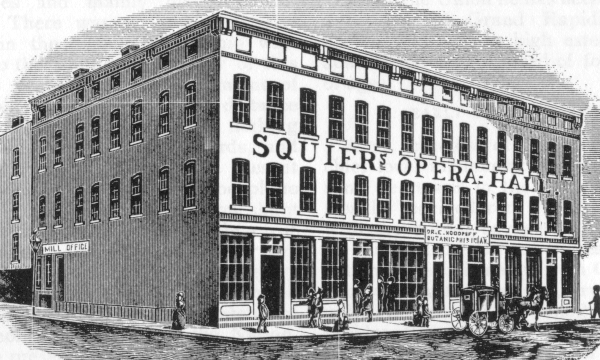
Opera in Grand Rapids began one Tuesday evening in September 1868, in Squire’s Opera House, where the Grau Opera Company presented Flotow’s Martha complete with orchestra and chorus. Announcing this important event in the cultural life of the city, the editor of The Eagle pled for a large attendance to “disabuse the public mind of an idea somewhat prevalent, that nothing but Negro minstrels and similar performances can be well patronized. The evening was an outstanding success, the opera “admirably presented to a full, appreciative and delighted audience,” and the Grau Company no less delighted–responded with a matinee encore of Auber’s Fra Diavalo. Though neither of these Victorian favorites is much seen these days, opera took root in Grand Rapids, producing results both curious and exciting. Within a year, high-spirited local performers presented Julius Eichberg’s now forgotten, The Doctor of Alcantara. The production, entirely in the hands of local amateurs, was an unqualified success, and even a June storm was unable to dampen the audience’s enthusiasm. Everyone, The Eagle reported, was “very amply repaid by the excellence of the performance.” The troupe, accompanied by over a hundred well wishers, took the show of the road, where Kalamazoo audiences greeted them with equal enthusiasm. Clearly, it was the musical (and social) event of the season. That no further efforts followed from this group must have been a grave disappointment, indeed.

But several years later, Professor Jaroslav Zielinski, a Polish émigré temporarily settled here, returned locally produced opera to Grand Rapids. Zielinski, whose excellent musical training and artistic tastes are evident in the reputation he enjoyed while living here, twice directed local amateurs in ambitious undertakings: in 1876, it was Bellini’s La Sonnambula, and in 1878, Thomas’ Mignon. Though Zielinski coached his troupe for months, Bellini proved too taxing for local voices. Mindful of the performers’ amateur status, The Eagle generously praised them, while concluding, “we think [Professor Zielinski] was too ambitious” in his choice of operas. Mignon, however, was just right for local voices, and the future of locally-produced opera looked bright. But Zielinski’s decision to go West ended all that.

Yet, this brief flirtation with local opera was the beginning of a decade in which opera came to Grand Rapids in a big way. During those years all the major impresarios–Grau, Holman, Strakosh, Gorman and Emma Abbott–brought their troupes to town. With them came opera light and heavy, sung by the competent and incompetent alike. Among the best known operas seen were Gounod’s Faust, Verdi’s La Traviata, Il Trovatore, and Un Ballo in Maschera which was actually the first Verdi opera heard in Grand Rapids! –Donizetti’s Lucia di Lammermoor and Linda di Chamounix. There were also several productions of Balfe’s Bohemian Girl and Planquette’s Chimes of Normandy, two chestnuts of a by gone age. In addition, the companies brought assorted operettas to lighten the season. And, of course, the Gilbert and Sullivan fever of the 1880’s did not spare Grand Rapids.

The performers who trouped through town during this busy decade make up a long list of the forgettable; but there were some memorable stars in the lot. The most famous–Clara Louise Kellogg and Minnie Hauk–appeared in concert operas, with neither sets nor staging. Miss Kellogg, who usually toured with her own company, sang a concert Il Trovatore, much to the disappointment of The Eagle reviewer, but not so for her small, enthusiastic audience. Miss Hauk brought Grand Rapids its first Carmen–her most celebrated role–but press accounts read more like a social than a musical event. The Penn Club, site of the after-theater party, was packed with everyone of standing in 1883 Grand Rapids society. All were anxious to meet not only the celebrated Miss Hauk, but also her husband, the Baron von Hesse-Wartegg, an Austrian nobleman of international fame.

Emma Abbott

But it was the Midwest’s own Emma Abbott who sparked the most enthusiasm during her six seasons here. Her Grand Opera Company introduced local audiences to Donizetti’s two ill-fated women (the mad Lucia and Linda of Chamounix), as well as Verdi’s Violetta, a role she was reluctant to sing because, she feared, “it would glorify fallen women.” Miss Abbott starred in most of her Company’s productions, but even on nights off she appeared at intermission to enthrall everyone with her “Last Rose of Summer,” “Swanee River,” and “Home Sweet Home.” She was America’s favorite songstress, and her Company always packed the Powers Opera House.

The next surge of opera activity in Grand Rapids came just after the turn of the century. In quick succession, Pietro Mascagni and Ruggero Leoncavallo, composers of those eternal twins, Cavalleria Rusticana and Pagliacci, each brought his alleged “La Scala” opera company to town. These were dazzling appearances, two internationally-famed composers conducting their own operas in concert performances. Audiences loved them, especially the flamboyant Mascagni, who entertained on and off the stage.

Operatically, the most interesting productions of the early years of this century were Wagner’s Lohengrin and Tannhäuser, both done in English by Henry Savage’s Grand English Opera Company. These two represent the only time Wagner’s operas were sung locally until Opera Grand Rapids’ 1989 production of The Flying Dutchman. Savage’s Opera Company played to capacity houses, and were warmly praised, reviewers concluding Grand Rapids was ready for both Wagner and top-notch performances. In the words of the Grand Rapids Press, “may Grand Rapids never be without its annual season of grand opera, and, if possible, Mr. Savage’s grand opera.”

Though the wish remained unfulfilled, the Savage Company did return a few years later with Puccini’s Madame Butterfly. This 1907 appearance was especially significant since it took place just after Butterfly’s American premiere, and Savage brought the original cast: Joseph Sheehan, Elza Szamosy and Walter Rothwell to conduct. It was a smash hit, easily making up for Savage’s four-year absence. The next year the New English Opera Company brought another Madame Butterfly, but this time The Daily News headline sadly reported: “Magnificent Production Poorly Attended.”

Other impresarios, however, were not discouraged with opera prospects in Grand Rapids. In quick succession, the Aborn Grand Opera Company made two separate appearances, even bringing another Butterfly. The following year Joseph Sheehan, star of the 1907 Butterfly, returned in 1912, with his own company for a season of Carmen, Bohemian Girl, and Martha. All were modest successes, but in 1916, overflow audiences greeted the Boston Grand Opera Company’s La Bohème, starring the Met’s own Maggie Teyte. The second half of this curious program featured Anna Pavlova and her Imperial Ballet Russe. An evening of a full-length opera followed by a complete ballet seems strange to modern audiences, but such mixed productions were then not unusual at all.

The following year, the Boston Company returned with two Met stars–Maggie Teyte and Riccardo Martin–in a Faust production that was, by all reports, magnificently sung. But a train accident cost the group its final act Walpurgis Night and both music and ballet had to be abandoned. In addition, the mishap forced the company to use La Bohème sets for the Act III outdoor scenes. All this the audience took in good spirits, and the Grand Rapids Press critic pronounced the Faust brilliantly presented.

For the next fifty years, opera in Grand Rapids fell on hard times. In 1923, Fortune Gallo’s San Carlo Opera Company tried a season, bringing back Madame Butterfly and La Bohème, while introducing local audiences to their first staged versions of those inevitable twins, Cavalleria Rusticana and Pagliacci. But this auspicious try was short lived as audiences were simply too small. Even the valiant efforts of an impressive list of local sponsors could not rescue opera for Grand Rapids during the twenties and early thirties. Clearly, the effects of motion pictures were being felt everywhere in the entertainment world.

But the San Carlo company returned in 1938, bringing with them a block-busting Aida, which played to 5,000 at the Civic.  Even the original Italian didn’t put the audience off, and for two more seasons the San Carlo brought Grand Rapids opera at its grandest and most glittering. Playing to full houses, opera seemed here to stay, but the outbreak of World War II ended all that.

In the years after the war, the Grand Rapids Symphony presented a series of annual opera concerts, with performers mainly from the New York City Opera Company. During these years, Maestro Desire Defauw scheduled Grand Rapids’ first Mozart and Richard Strauss operas! The 1958 Rosenkavalier starred Phyllis Curtin and Frances Bible, but sadly deleted all the male voices. For the 1957 Cosí Fan Tutte, Defauw employed a narrator, presumably to tie together the loose ends of Mozart’s opera. During these post-war years, Grand Rapids did see two fully staged operas, the first a New York Civic Opera production of Carmen. The cast consisted of talented, but largely unknown singers who were warmly praised by Press reviewer Gerald Elliot. Perhaps it was most fitting that the last touring company to bring opera to Grand Rapids was the Metropolitan. On December 12, 1951, the Met performed Johann Strauss’ Die Fledermaus before a packed Civic house. The traveling company, led by Brenda Lewis, was youthful and talented, prompting local reviewers to praise both the singing and acting. In addition, the sets and costumes were singled out as “magnificent.” On opening night, The Grand Rapids Press editorialized that the appearance of the Met was “an acknowledgment of [Grand Rapids’] importance as a musical center and as a leader in cultural affairs.” A proud boast that took a few more years to fulfill. But in 1966, opera returned to Grand Rapids for good, when The Opera Company of Western Michigan (as Opera Grand Rapids was first known) brought fully staged productions back to town. We can be thankful that for fifty years Opera Grand Rapids has presented us with outstanding productions, with ever-increasing skill and achievement, finally fulfilling the Grand Rapids Press’ proud boast.

by Gilbert R. Davis (originally published in 2007 by the Grand Rapids Historical Commission)

Dr. Davis has contributed notes for Opera Grand Rapids’ productions for over 35 years.


OUR FOUNDERS HAD A BOLD PROPOSITION: to build a professional opera company that would put Grand Rapids on the map for a very discerning audience. 50 years later, we are humbled to be the modern bearers of classical standards and modern ingenuity. Learn more.


SUPPORT OUR NEXT 50 YEARS

As an integral part of our city’s artistic fabric, it’s our responsibility to see to its continual flourishing. Please consider donating to Opera Grand Rapids to ensure our artistic excellence for the next 50 years and beyond. You’ve already made us great. With your support, there’s no limits to the height our voices can reach together. Give today.