
News

The unequivocally epic spectacle of a community-built “Aida”


This story is part of a series of 50 stories we are releasing to commemorate 50 years of opera in West Michigan. Browse more stories and follow our journey throughout the season.


10,000 patrons, 350 choristers, 16 horses, four elephants, and one unequivocally epic spectacle.

The Opera Grand Rapids production of Aida was a spectacle in the spirit of the ancient Egyptian court it portrayed. The production will stand forever as a testament to what’s possible when an entire community of strangers and friends comes together to create something beautiful.

The Opera Grand Rapids production of Aida was a spectacle in the spirit of the ancient Egyptian court it portrayed. Much like the grandest celebrations of the Old World, 1997’s Aida featured hundreds of singers, lavish costumes, a tiger, elephants, and a colossal audience. It remains the most ambitious production ever staged by the Opera company. With so many moving parts, every facet was bound to be epic—even the production’s hiccups. Before the evening was over, a wide cast of characters—some of whom were not part of the company—would play their parts, including a police escort and a stubborn tiger that wouldn’t come out of its cage.

To give the uninitiated an idea of the sheer scale on display that September night: the Opera’s normal chorus was supplemented with five extra choruses from other organizations, according to Kyle Irwin, who was chair of the Board of Directors of Opera Grand Rapids during the staging of Aida. “Doing Aida was about four years of preparation, and I think our end product showed it. We had to find people who had elephants. We had a friesian horse troupe. [Sixteen horses, to be precise—more horses than many performances have performers.] We had something for everybody.”

Imagine it: Before the sold-out crowd of ten thousand arrived that night, thirty wig and makeup assistants attend to eight principal singers and one hundred fifty extras. Weaving through the organized chaos of the dressing rooms are twelve wardrobe assistants and three stitchers. Golf carts ferry around personnel, speaker cabinets, microphones, and spools of wiring, pulling up alongside chariots parked in the wings. Three lighting supervisors stand in a nervous cluster over an expanse of dimmers and switches; they put hundreds of luminaries through their paces, creating brief, bright blooms of color on the stage. Bits of sound bubble from the fifty-four speaker cabinets stowed in every conceivable space. The eight subwoofers mumble thunderously. The scene is a storm of chatter, floating clouds of makeup powder, flashing lights, and fragments of sound coming from every direction. Yet everyone knows their places. By showtime, the maelstrom has been bridled, and eager thousands are transported to a King’s hall in ancient Memphis.

This isn’t to say everything went off without a hitch. For better or worse, Aida brought a measure of the suspense and courtly intrigue of its source material to Van Andel Arena that night. “As with anything in opera, there’s always drama,” said Irwin. “The evening of the performance, there was a gala dinner. Someone came up, tapped me on the shoulder, and said, ‘we don’t know where the programs are…’ That was close to seventy-five hundred programs. The sponsors and chorus and everyone wanted their acknowledgement.” A forgotten hero spent the first Act tracking down said programs, and during the intermission, they were finally delivered—alongside an escort by the police and fire departments. The programs’ return was even announced by the mayor. “I’m pleased to say there wasn’t a program left in the arena after the event, so all’s well that ends well,” said Irwin.

The buzz and pageantry surrounding Aida spread its magic far beyond Van Andel Arena itself. The Celebration on the Grand parade, which takes place the first weekend of September, featured a dose of ancient Egyptian splendor that year. Elephants, horses, and scores of chorus members in their costumes transformed Monroe Avenue into the Nile for a few hours that afternoon. And far beyond those shores, Aida was mentioned in the New York Times, the Washington Post, the Detroit Free Press, and many other national publications. Irwin is rightfully proud of the reputational boost the performance gave the opera company, and even Grand Rapids as a whole. “It brought us into the limelight. We finally got top billing.”

Aida is one of grand opera’s most beloved and oft-performed productions. It is performed all over the world with incredible frequency. Between 2009 and 2014, Aida was performed three hundred four times. By staging such a classic of the form, Opera Grand Rapids joined the ranks of the world’s foremost companies. In doing so at such a scale, the company honored the spirit of Aida’s composer, Giuseppe Verdi.

After completing Aida, Verdi desperately wanted its first performance to be open to anyone who wished to attend. Instead, the debut was staged in Cairo, an invitation-only affair for politicians, critics, and dignitaries. Verdi declined to attend; he reserved his energy and enthusiasm for the opera’s public debut in Milan. Staging Aida for eleven thousand people in the audience, from opera aficionados to those simply drawn by the grandeur, was a fitting tribute to the legendary maestro’s love of the people.

The thousands who were there that night, the hundreds of performers, and the dozens who planned for years to realize a nearly impossible scale of vision will never forget it. Aida will stand forever as a testament to what’s possible when an entire community of strangers and friends comes together to create something beautiful.

OUR FOUNDERS HAD A BOLD PROPOSITION: to build a professional opera company that would put Grand Rapids on the map for a very discerning audience. 50 years later, we are humbled to be the modern bearers of classical standards and modern ingenuity. Learn more.


SUPPORT OUR NEXT 50 YEARS

As an integral part of our city’s artistic fabric, it’s our responsibility to see to its continual flourishing. Please consider donating to Opera Grand Rapids to ensure our artistic excellence for the next 50 years and beyond. You’ve already made us great. With your support, there’s no limits to the height our voices can reach together. Give today.

Maestro Robert Lyall reflects on OGR’s legendary artists


This story is part of a series of 50 stories we are releasing to commemorate 50 years of opera in West Michigan. Browse more stories and follow our journey throughout the season.


What makes a great opera singer? Verdi was only half right.

What makes a phenomenal opera singer? Answering this question correctly is crucial for an opera company. The answer is an axis around which revolve a cast, a business, a symphony, even a wider community. At the center of the publicity, the construction projects, and the audience is the core from which the rest is built: an exquisite human instrument. People come to be dazzled by the voice. For over twenty-five years, the task of answering opera’s crucial question—what makes a phenomenal opera singer?—belonged to Opera Grand Rapids’ Maestro Robert Lyall.  

When asked this very same question, Lyall is quick to invoke immortal composer Giuseppe Verdi. “The classic response is to quote Verdi himself. He was asked the three most important characteristics of a great opera singer. He said, ‘Voce, voce, e voce.’ It’s voice. It’s what, in opera, we would call ‘the gift.’ A person can be a wonderful performer in so many ways, but a truly great opera performer must have a magnificent instrument that is properly trained to project over full orchestral sounds and fill a hall.”  

But here Lyall expands on Verdi’s pithy answer. While being a singer of surpassing quality is necessary, the maestro says a performer must also have theater skills. “There used to be an old joke that said the term ‘operatic acting’ is an oxymoron.’ Well I can assure you that in today’s world, it is not. Opera singers now train in all aspects of theater arts and physical conditioning to make themselves complete participants in the drama.” 

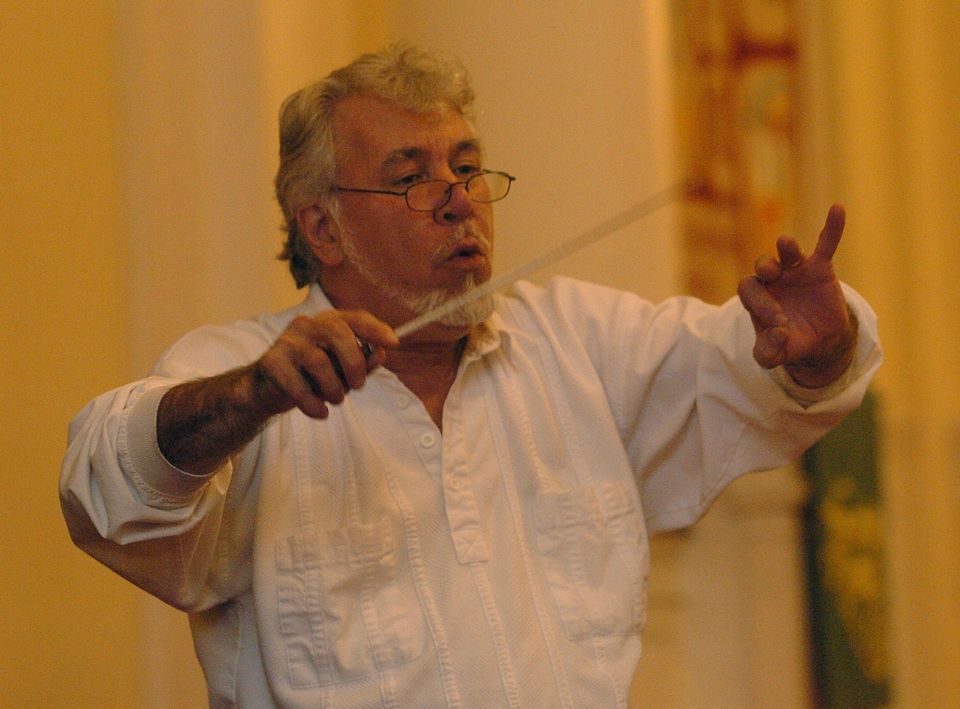
Maestro Lyall is an expert on the ingredients of that operatic drama. He joined Opera Grand Rapids in the autumn of 1989, and served as Artistic Director and General Director for twenty-six years. During his tenure, he had the pleasure of knowing a great many phenomenal opera singers, at many different chapters in their respective careers.  

According to Lyall, courting and featuring emerging artists is intrinsic to the role of the regional opera house. The world stages have their roles to play, certainly, but a regional company of great repute functions differently. “Hiring famous singers is often a question of funds, but to identify burgeoning, emerging talent, and looking at their potential, is a special path opera companies should follow, particularly with our native artists.”  

Piero Giuliacci, Aida 1997

Opera Grand Rapids has indeed hosted its share of famous performers. 1997’s Aida at Van Andel Arena featured Piero Giuliacci in the role of Radames. Giuliacci regularly performs all over the world, bringing classics like Tosca, La bohème, and Turandot to Shanghai, Rome, and, of course, Grand Rapids. “But accompanying him were many emerging talents who were singing at regional companies, and eventually ended up at the Metropolitan Opera.” It’s important to Lyall that the highly-visible principal singers are surrounded by gifted hopefuls who may one day become stars in their own right.  

Lise Lindstrom, The Flying Dutchman 200

Lise Lindstrom is another singer to grace the OGR stage during her rise to operatic prominence. Known as one of the world’s leading performers of both Salome and Turandot, Lindstrom has captivated audiences by bringing delicate shading and grace to some of opera’s most bombastic roles—something she did early on at OGR. 

Some artists who perform at Opera Grand Rapids are truly just beginning their careers, and go on to feature in opera’s legendary arenas. A young Brian Hymell had only performed one professional production when he sang Tamino in Die Zauberflöte at OGR. His career arc is a perfect encapsulation of Lyall’s philosophy—cultivate potential, and become part of the rising star’s story. “Look at him now,” says Lyall. “He graces the world stages, singing the major repertory at the Metropolitan Opera, Covent Garden, La Scala, and Vienna State Opera.”  

The pantheon of great singers who have taken our stage is a source of pride for the maestro. Says Lyall, “There is a long list of distinguished artists that were featured in the earlier phases of their career by Opera Grand Rapids. I’m probably more proud of that than if I had been able to hire the world’s leading celebrities. Celebrities have already arrived at their level of distinction. We wanted to have some ownership of the development of great talent.”  

Maestro Robert Lyall

In reflecting on his career, Lyall’s pride is always collective, spread around those who helped him sculpt a host of cherished memories. A clear sense of community and fellowship permeates his reflections. His pride in the Opera is matched by his love for the city itself. “[Having distinguished performers] is very special for establishing the role of Opera Grand Rapids in this city. This is a wealthy city in its intellectual promise, in its industrial promise, and we felt we had a very specific role to play in contributing that element to the quality of life that great arts can do,” says Lyall.   

The maestro is adamant that no discussion of his career is complete without mentioning the Grand Rapids Symphony Orchestra. Says Lyall, “This is one of the finest professional symphony orchestras in the country. My artistic partnership with them was one of the most gratifying parts of my work in Grand Rapids. We made great music together. We like to tout them as a partner in our ventures with great pride.” 

It’s clear that Verdi wasn’t wrong with his somewhat reductive take on what makes a great opera singer, but Maestro Lyall’s career suggests the quip may have been incomplete. Opera will always revolve around the voice. But that voice must be trained, recognized, and allowed to flourish. Directors must take chances on unproven artists in supporting roles, balancing the need to cultivate local and emerging talent with the public’s demand for exquisite performance. Dozens of musicians must play in perfect harmony, and the totality of the spectacle must form a moving story. The voice at the center must be sublime, but the voice alone is not opera. Perhaps a better question for the multimedia age is not “What makes a great opera singer?” but rather, “What makes a great opera?”  

Lyall himself explains it perfectly: “Opera is music, it is theater, it is art. When you’re working in opera, there is a unique set of challenges. Because of the lighting, the set design, the individualized personalities, as well as the glories of the sound of the full symphony orchestra, and the grand choral works that animate it. To me, it is truly the Wagnerian Gesamtkunstwerk concept—Opera is the total artwork.”


OUR FOUNDERS HAD A BOLD PROPOSITION: to build a professional opera company that would put Grand Rapids on the map for a very discerning audience. 50 years later, we are humbled to be the modern bearers of classical standards and modern ingenuity. Learn more.


SUPPORT OUR NEXT 50 YEARS

As an integral part of our city’s artistic fabric, it’s our responsibility to see to its continual flourishing. Please consider donating to Opera Grand Rapids to ensure our artistic excellence for the next 50 years and beyond. You’ve already made us great. With your support, there’s no limits to the height our voices can reach together. Give today.
A Look Through Opera’s Fashion Runway


This story is part of a series of 50 stories we are releasing to commemorate 50 years of opera in West Michigan. Browse more stories and follow our journey throughout the season.


With New York Fashion Week upon us, we revisit some of the most stylish patrons of New York’s venerable opera house.

The Metropolitan Opera is known for its elaborate costume design on the stage, but for celebrity and elite patrons attending the opera, what’s worn to the performance is just as important. The opera house understands this well, and has taken the initiative of featuring the fashions of its opera attendees through “Last Night at the Met” social media platforms.

Browse the entire gallery here.


OUR FOUNDERS HAD A BOLD PROPOSITION: to build a professional opera company that would put Grand Rapids on the map for a very discerning audience. 50 years later, we are humbled to be the modern bearers of classical standards and modern ingenuity. Learn more.


SUPPORT OUR NEXT 50 YEARS

As an integral part of our city’s artistic fabric, it’s our responsibility to see to its continual flourishing. Please consider donating to Opera Grand Rapids to ensure our artistic excellence for the next 50 years and beyond. You’ve already made us great. With your support, there’s no limits to the height our voices can reach together. Give today.

Rigoletto’s Stephen Gaertner on embodying a character, maturing into a role & more

Stephen as Macbeth, Savonlinna Opera Festival
Photo: Timo Seppäläinen, Itä-Savo


Since his Metropolitan Opera debut as Enrico in Donizetti’s Lucia di Lammermoor in October 2007, American baritone Stephen Gaertner has emerged as an artist to watch in the operatic world. His other roles at the Met have included Melot in Wagner’s Tristan und Isolde, Paolo in Verdi’s Simon Boccanegra, Montano in Verdi’s Otello and Chorèbe in Berlioz’s Les Troyens. He made his European debut in December 2010 with Opéra Royal de Wallonie in Liège, Belgium as Escamillo in Bizet’s Carmen. Recent career highlights have included an appearance with the 2013 Savonlinna Opera Festival in Savonlinna, Finland in the title role of Verdi’s Macbeth, a role he reprised for the 2015 Opernfestspiele Heidenheim in Heidenheim, Germany. He made his Italian debut in July 2016 with Teatro di San Carlo, Naples as Amonasro in Verdi’s Aida, and appeared in October 2016 with Teatro de la Ópera, San Juan, Puerto Rico as Iago in Verdi’s Otello.

This fall he sings the title role in Verdi’s Rigoletto with Opera Grand Rapids. We spoke with Stephen to learn more about his remarkable background and talents coming to the Opera Grand Rapids stage.


Stephen Gaertner

How did you come to opera?

I came to opera at a very young age. My mother was an opera fan. She was a fan of classical music, generally, and certainly of great singing. I just kind of had an ear for it. My mother would play records in the house and I enjoyed it very instinctively. I think I was about 10 years old when I was given a record of great old-time singers—an excerpts record, each artist doing one selection from an opera—and I started getting interested that way. And, eventually, I came to understand opera itself. It was so fascinating to me for some reason. I just latched onto it.

I had been studying violin and piano, and it sharpened my ear a lot, matching pitch with the printed music as well. I guess I always had perfect pitch, but that really improved my understanding of pitch as a sound and as an intonation. I was about 19 when I decided to go ahead and pursue singing, and it just made perfect sense.

How do you embody the role of Rigoletto?

First thing, of course, I learn the music, the words, the dramatic situation. Once that is done, I try to find other colors, other aspects of the character, and how I can relate to that. In the case of Rigoletto, he is a man who’s seen a lot of disappointment. He’s been greatly disadvantaged as a man who’s physically handicapped and, during his time, there weren’t many options for him. I don’t know much about his background, but I gather that he probably came from a good family that didn’t have anything to do with him because of his deformity, and that he had no choice but to be a court jester in a very decadent court—all of which caused a lot of bitterness in his soul. I take certain moments and allow myself to really, as they say, go there, and if I can somehow infuse that into the delivery of the lines, that’s how I’ll better be able to portray the character.

What will audiences like about Rigoletto?

The libretto is exceptionally strong. The story always makes an effect, no matter how it’s performed. It just always works. It was just so well put together, and on top of that, the music was absolutely one of Verdi’s best scores. Between the beauty of the melody and the atmosphere that Verdi was able to capture, it comes together so nicely.

Also, the character situation is relatable no matter which character you are looking at. There are several dimensions—from my own stand point—in Rigoletto. A lot of people see him as a despicable character, but they need to remember there is a soft side. If you allow yourself, you’ll find there’s probably a lot more that you can relate to. He is a man that has had incredible disappointment.

Verdi is often praised for his complex characterization in Rigoletto.

Prior to Rigoletto, most of his operas weren’t as three-dimensional. Most of the operas that he wrote were for specific theatres to make a career, essentially. But, by the time he got to Rigoletto, he was able to have more artistic control over his subjects that he set to music. Macbeth is one of the exceptions to that because it was a subject based on the Shakespeare play and he was a big fan of his. Some of his later operas have that Shakespearean complexity that appealed to him.

Given your experience portraying the roles of Rigoletto and Macbeth, do you have an affinity for Verdi?

I feel that his writing for the baritone voice really fits my voice perfectly. It’s become more so as my voice has developed and matured; it became more and more suitable. And, also, with time and maturity, I could relate better to the characters. Thankfully, I haven’t outgrown portraying characters on the young side as well. The music that those characters have to sing does call for a very strong and mature sound. It’s an interesting combination.

I recently performed my first Carlo in La Forza del Destino, and I waited a long time to have the opportunity, and to do it full justice. The character is on the young side, but the vocal writing is very mature. And, the voice part is rather rangy, as in all of Verdi. The parts require a strong top range (which had always been my strong suit), but they also require a strong and rich middle, which that has, for me, only come about recently. So now I can do better justice to these characters because my voice has really grown into the music and what it requires.

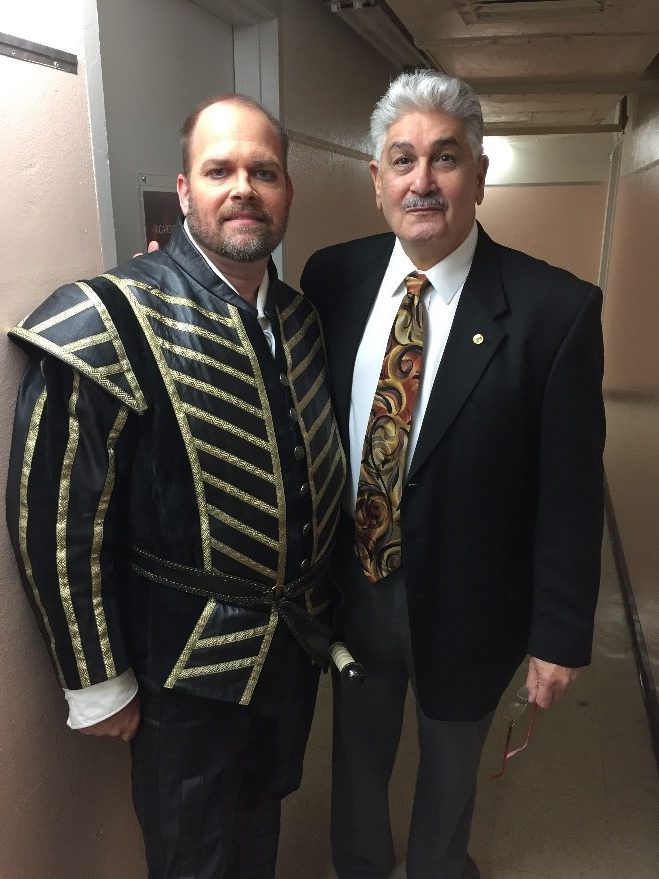
Stephen Gaertner (left) Justino Diaz (right)

Last year I performed the role of Iago in Otello in San Juan, Puerto Rico. In this particular case, I found this experience truly memorable primarily for vocal reasons, as I felt I had truly arrived at the point where my voice could do full justice to the music Verdi wrote for this character. Also, one of the performances was attended by one of the great interpreters of the role of Iago in the past several decades, Puerto Rican-born Justino Díaz! It was a tremendous honor for him to have greeted me afterwards and to have been incredibly complimentary to me.

What’s your most memorable experience from a production?

One of the most exciting experiences I had would be the first time I ever sang the title role of Verdi’s Macbeth in 2013 at the Savonlinna Festival in Finland, and I that was a venue I had always dreamt of performing at. The opera festival takes place in a converted courtyard of a fortress located in the middle of a lake. What a perfect ambience for an opera like Macbeth! Two dreams coming true together—it was truly special.

I had always been attracted to performing opera in concert form as well, mostly because most operas performed in that way are less well-known and yet the music is certainly worth hearing. Probably my favorite experience, in that regard, happened almost at the last minute. In November 2015, I received an email out of the blue from Opera Rara in London. This is a company that records and performs lesser-known operas from Italian bel canto and French repertoires—and they were venturing into their first ever projects from the Italian verismo period. They were doing Zazà—an opera I happened to have performed in concert in New York back in 2005and they had lost their lead baritone. I was recommended by the Metropolitan Opera to fill in, and the experience involved recording the opera for a CD release and performing it live at the Barbican Hall in London.

What would you say to someone who has never been to an opera?

I think a lot of people have preconceptions about the experience of going to the opera that might not necessarily be a positive one—and we’re certainly not inundated with that type of singing in our daily lives. But I think when they come to an opera and see so much else that goes into it, I would like to think that they would change their minds.

With Rigoletto, you will see a wonderful story, hear incredible music coming from the orchestra and on stage, hear incredible voices making these unbelievable sounds—and if they are singing in a different language, we now have translated titles in our theatres that will help you understand better what’s going on to enhance the experience greatly. I would say give it a shot because there’s really nothing like it. I would say this is definitely one opera that is a good one to start with if you’ve never been to an opera before. It’s one of those, say, five operas that’s good to start with.


October 13 & 14  |  7:30 PM  |  DeVos Performance Hall

OPERA  |  CLASSIC  |  DRAMA  |  ITALIAN

Italian grand opera at its finest.

Tickets and more.

Opera in Pop Culture (our favorites)


This story is part of a series of 50 stories we are releasing to commemorate 50 years of opera in West Michigan. Browse more stories and follow our journey throughout the season.


From a hip-hop musical film starring Queen Bey to one the greatest cartoons of all time.

Opera is deeply ingrained in our popular culture. The art form has long been a rich source of themes seen in film, TV, advertisements, and more recently, video games. Opera has helped to amplify the most dramatic scenes in movies, inspired all-out parodies and fanciful plot devices, and added comic relief to a plethora of TV advertisements. We’ve collected some of our favorites below. Stay tuned. There will be more to come!


Citizen Kane

Citizen Kane, the 1941 American film by Orson Welles, features the character Susan Alexander–Kane’s love interest–in a humiliating operatic career for which she has neither the talent nor the ambition. Herman J. Mankiewicz, Welles’ co- screenwriter, intended to feature in the film an opera sequence from Jules Massanet’s Thais. Ironically, Massenet wrote the role of Thais for Sybil Sanderson who was, at one time, engaged to newspaper tycoon William Randolph Hearst–the man who’s life forms the basis of Welles’ film. However, due to copyright issues at the time of the film’s production, Herrmann instead wrote selections in French verismo style from the ersatz opera Salommbo.


Carmen the Hip Hopera featuring Beyoncé

Carmen is often thought to be the most popular and recognizable opera of all time. A quick search on the IMDb database results in an astounding 136 films that feature the opera’s famous “Habanera” aria. Queen Bey takes it a step further in this throwback made-for-tv musical film loosely based on the opera’s story. Borrowing elements of the opera’s themes of seduction and jealousy, Carmen the Hip Hopera is set in Philadelphia and Los Angeles in modern times and features a mostly original hip-hop/R&B score. The hip hopera features Beyoncé in her debut acting role.


Porgy and Bess “Summertime” by Ella Fitzgerald and Louis Armstrong

George Gershwin’s “Summertime” is recognized as one of the most covered songs in the history of recorded music, featuring over 33,000 covers. The song, from the 1935 opera Porgy and Bess, soon became a popular and much recorded jazz standard, described as “without doubt … one of the finest songs the composer ever wrote.” Jazz legends Ella Fitzgerald and Louis Armstrong offer their interpretation from their 1958 awarding-winning album of the opera considered to be the most musically successful among the jazz vocal versions of the opera.


Warner Bros. Cartoon “What’s Opera Doc?”

“What’s Opera, Doc?” is a 1957 animated cartoon musical short featuring Elmer Fudd chasing Bugs Bunny through a parody of Richard Wagner’s operas, particularly Der Ring des Nibelungen, Der Fliegende Holländer, and Tannhäuser. The cartoon borrows heavily from the second opera in the “Ring Cycle” Die Walküre, woven around the standard Bugs-Elmer conflict. The cartoon is widely regarded as Chuck Jones’ masterpiece, and many film critics, animation fans and filmmakers consider it to be the greatest of all Warner Bros. cartoons. It has topped many Top Ten lists of the greatest animated cartoons of all time. It was rated by a panel of over 1000 animators in Jerry Beck’s 1994 book The 50 Greatest Cartoons: As Selected by 1,000 Animation Professionals as the greatest cartoon of all time. In 1992, the United States Library of Congress deemed it “culturally, historically, or aesthetically significant”, and selected it for preservation in the National Film Registry, making it the first cartoon to receive such honors.


The Simpsons’ ‘Homer’ Sings Opera

The second episode of The Simpsons‘ nineteenth season features title character Homer Simpson who, after gaining the ability to sing opera following an accident, becomes a professional and famous opera star. There’s a catch, however: Homer must sing while lying on his back for his voice to sound operatic. Guests stars include Plácido Domingo as himself and Maya Rudolph. The episode was nominated for a Writers Guild of America Award in 2008.


OUR FOUNDERS HAD A BOLD PROPOSITION: to build a professional opera company that would put Grand Rapids on the map for a very discerning audience. 50 years later, we are humbled to be the modern bearers of classical standards and modern ingenuity. Learn more.


SUPPORT OUR NEXT 50 YEARS

As an integral part of our city’s artistic fabric, it’s our responsibility to see to its continual flourishing. Please consider donating to Opera Grand Rapids to ensure our artistic excellence for the next 50 years and beyond. You’ve already made us great. With your support, there’s no limits to the height our voices can reach together. Give today.