A glimpse into Rigoletto from Stage Director Stephanie Havey
Stephanie Havey
Verdi’s Rigoletto is based on Victor Hugo’s 1832 play Le Roi S’amuse (The King Amuses Himself), which centers on the excesses of a cynical and ruthless king who revels in the cruel treatment of his courtiers, particularly his jester. Hugo’s play was met with censorship issues from the beginning. The censors feared that the character of the ruthless king mocked the current king of France, and therefore banned the play after one performance.
To avoid Hugo’s difficulties with censors, Verdi moved the play from the French court to Mantua Italy and changed the king to a duke. He also changed the title of the opera to La Maledizione (The Curse) and eventually changed it again, to Rigoletto. Both titles shifted the focus of the story from the depravity of the master to the drama of his jester. The plot now focused on the tragic story of Rigoletto, who is trapped in an impossible predicament and who eventually suffers one of man’s most horrid fates.
Our production remains in the original setting of the Renaissance, with elaborate period costumes and painterly images. Hovering above our set is the pristine model of an unobtainable ideal city, based on a painting by Piero della Francesca. Below, we find ourselves drawn into the dangerous, corrupt court and that of a sinister, dark world around it. The shadowy world of the Duke is ruled by desire and the pursuit of power. The courtiers become voyeurs to the Duke’s entertainments and wait like birds of prey for their share of the spoils. Those who fall victim to the quickly shifting alliances at court will surely find dishonor, or even death. At the end of the first scene, Rigoletto and the Duke are cursed by Monterone, one such dishonored courtier. This curse represents a moment of mental collapse for Rigoletto and becomes the catalyst for the events of the opera.
The jester instantly begins to view the world through a lens of fear and paranoia that confuses nightmares with reality. Images from the Duke’s court reappear and become increasingly distorted and grotesque as Rigoletto is overwhelmed by his obsessive fear. Outside of the court, the world is dark and empty. In Rigoletto’s home, there is only an angelic visage watching over his daughter Gilda. This image represents the mother figure that Gilda so desperately clings to as a source of hope and salvation. In the final scene, there is only the image of a body with no face, representing both an object of desire and the indifferent fate of Sparafucile’s victim. The imagery becomes more heightened and focused until finally Rigoletto is left alone in the dark with only the ideal city to remind him how far he has fallen. This production is an exploration of the psyche of Rigoletto, while always seeking to honor Verdi’s idea of the character as “grossly deformed and absurd but inwardly passionate and full of love.”
-Stephanie Havey
October 13 & 14 | 7:30 PM | DeVos Performance Hall
Stop whatever you’re doing and go try Love’s Ice Cream’s new, limited-time-only flavor in honor of Rigoletto.
Sacrifire and Ice
Opera Grand Rapids and Love’s Ice Cream have collaborated to release a new small-batch ice cream flavor in celebration of Opera Grand Rapids’ upcoming production of Rigoletto this weekend.
Rigoletto, the court jester, is known to mock those that fall victim to the Duke’s seductive advances. When the Duke sets his eyes upon Rigoletto’s own carefully-hidden daughter, Gilda, the jester vows to have revenge, but a curse is cast upon him. Tragedy strikes when the vulnerable young maiden becomes a helpless pawn in her father’s quest for vengeance.
The limited release ice cream offers two flavors in one unique presentation! Sacrifire & Ice features a golden floral mint ring (mint and geranium) signifying Gilda, her world being the cool, delicate and sheltered contrast to the Duke’s. Gilda means “sacrifice” but also means “golden”. The spicy black fennel core is a stark contrast, representing the Duke’s gritty, nefarious world, and the inevitable fate of the curse on Rigoletto. Learn more about the story of Rigoletto.
For a limited time only, Sacrifire & Ice is available at the Love’s Ice Cream store in the Downtown Market. Don’t miss your chance to get a taste before it runs out!
For more information on Love’s Ice Cream and their flavors, visit lovesicecream.com.
Opera Grand Rapids and Love’s Ice Cream began partnering in 2014 to offer specialty ice cream flavors in honor of each opera production. Take a look back at some of their previous creations below!
A healthy extra dark chocolate flavor “The Darkest Depths of Hellth” for Orpheus and Eurydice.Contrasting ingredients meet in “Fortune’s Fool” flavor inspired by Romeo and Juliet.“Madcap Figaro!” includes Madcap coffee ice cream with a hidden fig-orange swirl, perfect for the madcap opera, The Barber of Seville.Spicy yet sweet, “Orange Habanera” inspired by Georges Bizet’s Carmen“Red Light Tango-rine” flavor for Astor Piazolla’s Maria de Buenos Aires.
October 13 & 14 | 7:30 PM | DeVos Performance Hall
This story is part of a series of 50 stories we are releasing to commemorate 50 years of opera in West Michigan. Browse more stories and follow our journey throughout the season.
One reason that live theatre is still flourishing in the digital age—it feels dangerous, and where there is danger, there is also vitality.
There is a conflict that lives in the bones of all theatre. The conflict is fundamental to the stage, as each performance is one battle in a war that will never be resolved. It is the war against mishap—against disorder itself. Its skirmishes come in wardrobe malfunctions and missing programs, its bloodiest clashes in botched scenes and canceled shows. Whether you’re at a performance of The Magic Flute or Magic Mike, there is a series of near misses waiting in the wings. This is one reason that live theatre is still flourishing in the digital age—it feels dangerous, and where there is danger, there is also vitality.
The audience is never hoping for chaos. But its looming presence, held at bay through endless rehearsals and dogged people, is what fills the theater with energy, night after night.
Paula Tibbe is one of those people keeping chaos at bay. She’s cheerful, with an easy laugh—not what you might picture when you hear the phrase “enemy of entropy.” She prefers the phrase “singer mama.” But make no mistake: Paula is one of the people ensuring that the rickety juggernaut of each performance makes it over the finish line.
In theatre, there are always hitches. Grace is a matter of keeping them out of sight, or making them look intentional. This is something Paula has had a lot of practice with in her twenty-one seasons as chorus coordinator. Sometimes, the problems are minor, like the time Paula noticed a chorus member’s slip slide out of her costume and lay on the stage. She had to retrieve the garment, trying to stay invisible in front of hundreds of people. Other times, the surprises are severe, such as when the ground begins creaking and cracking beneath the actors’ feet.
During her very first year as chorus coordinator, Paula had a titanic job. The role is already heavy with personnel management: “It saves the artistic capabilities of the chorus masters to work with the chorus. I will answer the questions: ‘What page are we on? Where’s the cut? What shoes do we wear? What time is rehearsal? Do I really have to come to rehearsal?’” But Paula’s first show as chorus coordinator was a trial by fire—the massive Aida. For Aida, everything was realized on a grand scale, and the chorus was no different. The production’s huge proportions meant using choruses from six area colleges and Opera Grand Rapids. It was while this enormous assembly of visiting singers was congregated on a story-high stage for rehearsal that things went awry.
“It wasn’t reinforced enough, or we had too many people in one section,” says Paula. “I personally did not go down, but the people next to me went down.” The structure began to collapse with dozens of people still aloft, and the orchestra underneath. “You’re singing, and you look to your left, and you look to your right, and people are no longer there.” Despite the collapse, everyone escaped unscathed. This is when Paula’s job begins—in the midst of chaos.
Her job as chorus coordinator was to get the mass of people into seats and account for everyone’s safety, calming and funneling, taking head counts. When someone inevitably says, “the show must go on,” Paula is one of the people who steps forward.
Paula’s road to being a stage collapse first responder was a long one. It began while she was singing in church. After the service, someone approached her and told her she should audition for the chorus of Opera Grand Rapids. This person happened to be a principal singer in an upcoming performance of La Bohème, and staying with a member of Paula’s congregation.
The audition went swimmingly, and Paula was in. Her first experience with opera was watching the dress rehearsal of that same show.
“I can remember watching La Bohème and not having any idea what was happening. At the end, I was sitting there and just bawling, because Mimi dies. I was so moved by that.” After this emotional induction into the world of opera, Paula was introduced to other members of the chorus. They took her in and made her feel at home. She’s been with Opera Grand Rapids ever since. Thirty-four years later, the chorus has become a second family for Paula.
Il Trovatore Women’s Chorus
“I love working with the chorus. It is a large collection of people from all walks of life who find joy in making music together. We have heart surgeons, school principals, we have bus drivers, retirees. We have people meet their spouses in the chorus. They have babies, they have losses, they have their houses burn down. We are like a huge family, and we support one another. I always say, ‘We need to be kinder than necessary.’ We have people coming for their first production, and we have people who have been there twenty years. We need to be kind to everybody, and welcome them, and help them learn the ropes.”
OUR FOUNDERS HAD A BOLD PROPOSITION: to build a professional opera company that would put Grand Rapids on the map for a very discerning audience. 50 years later, we are humbled to be the modern bearers of classical standards and modern ingenuity. Learn more.
SUPPORT OUR NEXT 50 YEARS
As an integral part of our city’s artistic fabric, it’s our responsibility to see to its continual flourishing. Please consider donating to Opera Grand Rapids to ensure our artistic excellence for the next 50 years and beyond. You’ve already made us great. With your support, there’s no limits to the height our voices can reach together. Give today.
This story is part of a series of 50 stories we are releasing to commemorate 50 years of opera in West Michigan. Browse more stories and follow our journey throughout the season.
The legendary baritone shares which musicians he admires most, how tragedy helps shape his characterizations, and why Grand Rapids audiences are so dear to him.
Blackmail. That’s what launched Mark Rucker’s thirty-four-year career in opera.
In High School, Mark played football. He had a music class, but his heart belonged to football. One day, his teacher walked up to him and said, simply, “You’re going to be an opera singer.” Time would prove her correct. Rucker would go on to dazzle audiences with his rich baritone for decades, from Covent Garden to Carnegie Hall. But he didn’t know that yet.
“Leave me alone, you crazy lady,” Mark replied, by his recollection. This was not the response his teacher was looking for.
“She proceeded to fail me in music class,” relates Rucker. “In order to keep me from being able to play football.” His teacher made a proposal: sign up for chorus, get a better grade, and regain eligibility for football. “I thought, ‘this is not something that should be allowed.’” But this was no average teacher. “When they built the new building, they gave her the shovel,” says Rucker. “She had power. I didn’t have any. So, I said, ‘OK, fine. I’ll join chorus.’”
Lena McLin
This makes more sense when you learn that his teacher was the legendary Dr. Lena McLin, niece to Tommy Dorsey, and a cultivator of talent who critic Howard Reich called “the woman who launched a thousand careers.” McLin’s roster of famous students includes R. Kelly, Chaka Khan, Da Brat, Mandy Patinkin, and many others, including Rucker.
“When I debuted at the Metropolitan Opera in 2004, she was in the front row,” says Rucker. It’s clear McLin’s tough-as-nails approach and belief in his potential had a profound effect on his life, as well as his own perspective on teaching music. “If it hadn’t been for this woman, I wouldn’t be talking here,” he says.
As a teacher in MSU’s School of Music, Rucker carries on that tradition of serious tutelage. “But not quite as aggressively,” he says with a smile. “I give as much of myself as I can. I’m somewhat of a conservative teacher, in that I don’t push people to do more than they should do when they should do it.” He’s careful not to damage his students’ voices with overly strident instruction, as this can be a problem in musical academia. “It’s my honor to be able to teach them. They come to me with their hearts, and I give them mine.”
Whether he’s teaching aspiring professional singers, or composition students who must take one vocal performance class, his approach is the same. Even if they never become singers, they still have a role to play, says Rucker. “They might become a lover of the art form. That’s as important as having the singer on the stage. Without having those people in the audience, there is no stage.”
The audience has a special place in the veteran singer’s heart. When reflecting on performing with Opera Grand Rapids, his first and fondest memories are of the people offstage. “I have memories of one of the most fantastic audiences I’ve ever seen. They were so involved in what you were doing. They didn’t see Mark Rucker, they saw a character. And they appreciated it.”
Maestro James Meena, Opera Grand Rapids Artistic Director
But Rucker does reserve some of his admiration for some of OGR’s most well-known faces. He counts our opera as indescribably lucky to have been helmed by Maestro Robert Lyall, followed by Maestro James Meena. “They’re two of the greatest musicians I’ve ever met in my entire life,” he says. “You will never meet a more exciting conductor than James Meena. They don’t exist. Even if you don’t want to come for the opera, you’ve got to come to see him.”
Rucker can’t say enough about his respect for the nuance and grace his fellow performers bring to every show. For performers, life doesn’t stop its ceaseless march for a production. Tragedy must be taken in stride—it is over and through life’s vicissitudes that performers often forge bonds, and even draw their power. He recalls one such bittersweet memory:
“I was doing Rigoletto, and the young lady who was singing Gilda, her mother was dying. She would go back every weekend to see her. And I was trying to figure out, ‘how do you make yourself do that?’ I remember having to try and stay in the act, because she’s dying in my arms. She was starting to cry, and I couldn’t help myself, but I told myself to stay in it. I remember at the end, we were both just crumbling. And I said to her, ‘you know what? We have to bow. Get up.’” But something crystallized for Rucker. He realized at that moment that the title character himself was enduring a similar tragedy. “Until you’ve experienced something, it’s hard to relate to that kind of pain.”
Mark Rucker as Rigoletto
Recounting the incident, Rucker easily brims with the emotion of that evening, trapped on stage between grief and an expectant audience. “That night, I remember gaining so much strength from her. It led me to another place in the character. Even today, I want to find new things about a character. I never want to be the same. That gave me an insight into the character that I use to this day.”
When his own father passed away, Rucker was in a production of La Traviata with James Meena. He left the rehearsal briefly for the funeral, but returned shortly after. He remains grateful to Meena for having faith in him to return and carry his performance forward. “I used the same thing I used when I did Rigoletto.” He channeled the grief into his performance, and stayed in character. It was a difficult era, but the singer let the work be his guide.
This way of working through one’s darkest days has never left Rucker. In great operatic tradition, it will be part of his legacy, as he passes it to his students. When they come to a lesson with personal problems, such as a breakup, Rucker’s approach is a synthesis of all he’s learned on stage, with a dash of his old teacher’s seriousness of purpose: “I’ll say, ‘I don’t care. Right now, we’re working. After the lesson is over, we’ll talk about your girlfriend.’ Right now, we work. Because that’s the one thing an artist needs to be able to do.”
The singer has lived this truth many times. And ultimately, that truth is about more than opera—it’s about cultivating the soul of an artist. “I’m still working that way. I tell my students the same thing. You’ve got to use what you’ve got and work through it.”
OUR FOUNDERS HAD A BOLD PROPOSITION: to build a professional opera company that would put Grand Rapids on the map for a very discerning audience. 50 years later, we are humbled to be the modern bearers of classical standards and modern ingenuity. Learn more.
SUPPORT OUR NEXT 50 YEARS
As an integral part of our city’s artistic fabric, it’s our responsibility to see to its continual flourishing. Please consider donating to Opera Grand Rapids to ensure our artistic excellence for the next 50 years and beyond. You’ve already made us great. With your support, there’s no limits to the height our voices can reach together. Give today.
This story is part of a series of 50 stories we are releasing to commemorate 50 years of opera in West Michigan. Browse more stories and follow our journey throughout the season.
One of the country’s longest-serving Technical Directors on the fun in opera and the nonsense in rock n’ roll.
The stage is dark, save two broad pools of dim purple-blue light in the center. Even in this light, you can see their beards; the men standing in the dark onstage cut iconic silhouettes. Across a sea of people, Keith Oberfeld stands with a starship’s worth of sliders and dials at his fingertips. There will be music, but the magic here is his job. On cue, Keith’s hands flit over the massive light board just as the room explodes with sound. A lazy, sleazy, searing guitar cuts through the din of the crowd as the stage becomes a wash of swirling psychedelic purple. Keith makes a tiny gesture in the lighting booth, and two spotlights bring the bearded men forth from the haze. Soon, the arena throbs with the sound of Billy Gibbons’ declaration that he’s bad, and also nationwide. The year is 1979 and Keith Oberfeld is doing lights for south Texas rock juggernaut ZZ Top. This pedigree is not what one may imagine for the origin story of a man with three decades of experience inside an opera house.
“Touring rock n’ roll is crazy. All aspects. Everything you’ve heard about it is true,” says Oberfeld.
After running lights for bands like ZZ Top and Blondie for a few years, Oberfeld was ready for something a little calmer. “Opera seemed like a natural place to go after that nonsense,” he says. He had done volunteer work for community theater before and learned a lot about lighting design; his interest in theater and expertise in production landed him a job as master electrician in our very own DeVos Hall. After a few years of keeping the lights on, Oberfeld was ready for a career that combined his technical knowhow with his artistic inclinations. That opportunity came in the form of Opera Grand Rapids’ Technical Director position. He took the job in 1984, and has been the man behind the magic of stagecraft ever since.
As one of the longest-serving Technical Directors in the country, Oberfeld is one of the elder statesmen of the Grand Rapids Opera. He has seen administrations come and go, weathered renovations, and worked with countless performers and conductors over the course of some one hundred operas.
For each of these shows, Keith is at the helm of all things technical. “I work on figuring out where the scenery is going to hang, how it’s going to get loaded in and assembled, where the lighting is going to go in reference to the scenery, work with the lighting designer to make all that work together, work with the director to discuss scene changes, work with the costume people to see how costumes will integrate, and coordinate sound and special effects. I put everything together. All the design and practical aspects of the production.”
Considering how many moving parts are involved in just one show, dealing with problems that arise is a large part of Keith’s role. Sometimes these hurdles are as simple as replacing a burnt-out lightbulb. Other times they involve fire. Sometimes intentionally, other times, less so.
The Flying Dutchman 2009
In the eighties, Opera Grand Rapids staged a massive production of The Flying Dutchman. OGR had rented a set from San Diego Opera—a grandiose background to represent the titular Dutchman’s ship. During rehearsal one day, a piece of this scrim caught fire. (This was not in the script, if you’ve never seen the show.)
Moments later, four Grand Rapids fire companies and presumably some concerned stagehands with fire extinguishers were fighting a blaze inside DeVos Hall. Luckily, the fire was under control within minutes. True to the show business cliché, rehearsal continued as the fire trucks drove away.
Most of the time fire finds its way into a production, it is by design. When, for instance, Don Giovanni goes to hell (we apologize for the spoiler), it’s Keith’s job to get things looking and sounding properly infernal. “We have a lot of fog, special lighting, explosives. Any time you can do a lot of special effects on stage, it’s always a lot of fun,” he says. To bring hell to the theater, Opera Grand Rapids must submit a plan to the fire marshal months in advance, containing exact specifications of the pyrotechnic devices to be used. When it’s time to bring the heat, a local licensed professional actually runs the pyrotechnics. “It adds quite a bang to the production,” deadpans Oberfeld.
Even after a professional lifetime doing an often arduous job, it’s clear that Keith still loves what he does. “One of the great things about working in opera is you get to stretch across all of the disciplines. You get to work with large orchestras with great conductors and beautiful music, you get to use projections and lighting to more effect than a standard production. You get to use sound effects and large scenery. Opera is a challenge in that it stretches every department in the theater, and that makes it particularly fun.”
Keith is an essential part of Opera Grand Rapids. One can’t overstate the value of an unflappable veteran of the stage who knows his lights and explosives. And for those who mistakenly think opera is entirely the purview of high society types—flag down Keith sometime and extract a tale of that infamous rock n’ roll excess we occasionally hear about. Provided he’s not busy putting out a fire, he won’t disappoint.
OUR FOUNDERS HAD A BOLD PROPOSITION: to build a professional opera company that would put Grand Rapids on the map for a very discerning audience. 50 years later, we are humbled to be the modern bearers of classical standards and modern ingenuity. Learn more.
SUPPORT OUR NEXT 50 YEARS
As an integral part of our city’s artistic fabric, it’s our responsibility to see to its continual flourishing. Please consider donating to Opera Grand Rapids to ensure our artistic excellence for the next 50 years and beyond. You’ve already made us great. With your support, there’s no limits to the height our voices can reach together. Give today.


 Our production remains in the original setting of the Renaissance, with elaborate period costumes and painterly images. Hovering above our set is the pristine model of an unobtainable ideal city, based on a painting by Piero della Francesca. Below, we find ourselves drawn into the dangerous, corrupt court and that of a sinister, dark world around it. The shadowy world of the Duke is ruled by desire and the pursuit of power. The courtiers become voyeurs to the Duke’s entertainments and wait like birds of prey for their share of the spoils. Those who fall victim to the quickly shifting alliances at court will surely find dishonor, or even death. At the end of the first scene, Rigoletto and the Duke are cursed by Monterone, one such dishonored courtier. This curse represents a moment of mental collapse for Rigoletto and becomes the catalyst for the events of the opera.
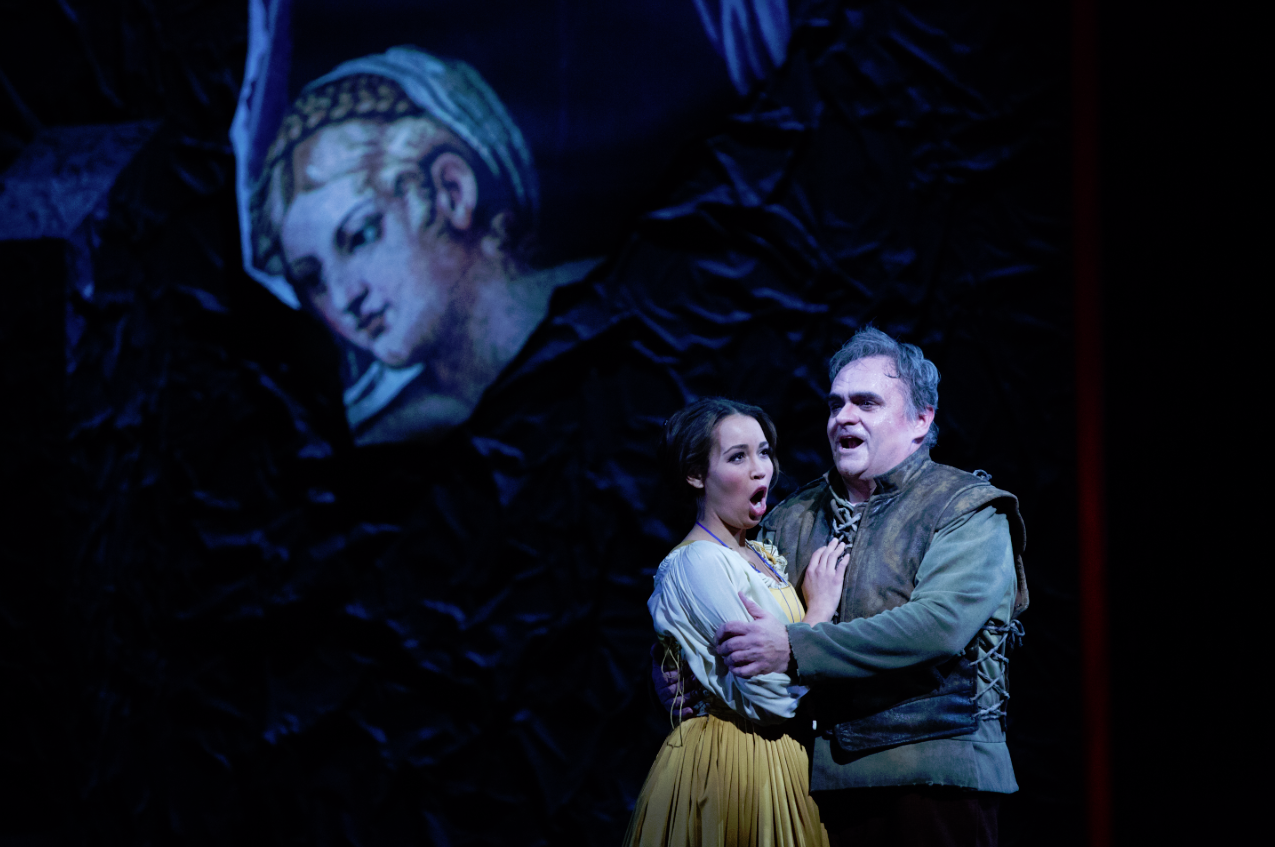 The jester instantly begins to view the world through a lens of fear and paranoia that confuses nightmares with reality. Images from the Duke’s court reappear and become increasingly distorted and grotesque as Rigoletto is overwhelmed by his obsessive fear. Outside of the court, the world is dark and empty. In Rigoletto’s home, there is only an angelic visage watching over his daughter Gilda. This image represents the mother figure that Gilda so desperately clings to as a source of hope and salvation. In the final scene, there is only the image of a body with no face, representing both an object of desire and the indifferent fate of Sparafucile’s victim. The imagery becomes more heightened and focused until finally Rigoletto is left alone in the dark with only the ideal city to remind him how far he has fallen. This production is an exploration of the psyche of Rigoletto, while always seeking to honor Verdi’s idea of the character as “grossly deformed and absurd but inwardly passionate and full of love.”










 This story is part of a series of 50 stories we are releasing to commemorate 50 years of opera in West Michigan. Browse